If your website serves visitors from different countries, offering support in only one language is guaranteed to create friction. Customers feel unsure, misunderstood, or simply bounce when they can’t communicate comfortably.
That’s where multilingual chat support becomes a game-changer.
With PushEngage’s chat widget, you can automatically show the right language version of your chat to the right visitor—no separate widgets, no complicated setup, and no reliance on external translation apps. In just a few minutes, you can create localized support experiences that feel natural, personal, and trustworthy.
In this guide, you’ll learn how to set up multilingual chat on your site, target different languages, and create a seamless experience for every visitor, no matter where they’re from.
Send Multichannel Messages Today!
Push and WhatsApp messaging are super effective, low-cost marketing tools to help you grow your repeat traffic, engagement, and sales on autopilot.
Why Multilingual Chat Matters
Before jumping into the setup, here’s why this is worth your time:
1. Increases trust instantly
A visitor who sees support in their native language is more likely to stay, explore, and buy.
2. Reduces confusion and errors
Misunderstood instructions create support load and frustration. Localized chat avoids that.
3. Improves conversions
Shoppers are far more likely to complete a purchase when the support experience feels local.
4. Makes your site feel global
Even if you’re a small business, multilingual chat gives you a world-class customer experience.
How PushEngage Supports Multilingual Chat
PushEngage lets you:
- Create multiple chat widgets in different languages
- Use URL targeting for different versions of your site to serve chats in different languages
- Set up Country Targeting triggers to serve chats in specific countries
- Use Agent Languages to offer multilingual support staff
No external translation tools are required — you maintain full control over all content.
A Simple Time Zone Coverage Plan (Even for Small Teams)
Another cool way to offer chat in multiple geographies and languages is to schedule your agents accordingly. Here’s an example schedule for a team of three agents in different time zones:
| Agent | Location | Hours (Local) | Approx. Global Coverage |
|---|---|---|---|
| A | India (IST) | 9 AM – 5 PM | APAC + Early EU |
| B | Europe (CET) | 8 AM – 4 PM | EU + Early US |
| C | US (EST) | 9 AM – 5 PM | Full US + Late EU |
With this structure:
- EU is covered almost the entire day
- US mornings overlap with EU evenings
- APAC mornings overlap with EU mornings
- You generate ~18–20 hours of daily live coverage automatically
Small team → large presence.
Now, let’s set it up inside your website.
How to Set Up Agent Schedules in PushEngage (WordPress Tutorial)
This section walks you step-by-step through the actual setup inside PushEngage.
Step 1: Open Your WordPress Dashboard & Go to PushEngage
- Log into WordPress
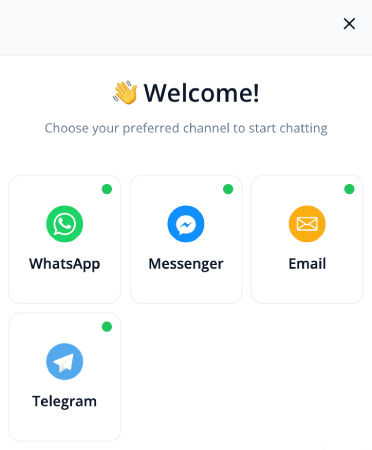
- Navigate to: PushEngage » Chat Widgets and click on Create a New Chat Widget
- Add channels to your chat widget and scroll down to Enabled Channels
- Click the edit icon next to the channel to update agent details
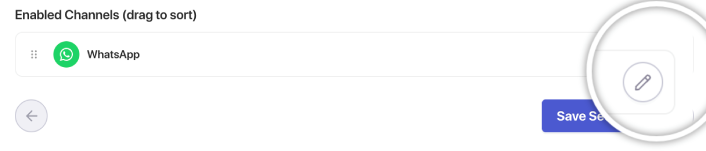
This is where your agent list lives.
Step 2: Add or Edit an Agent
Click Add Agent or select an existing agent to edit.
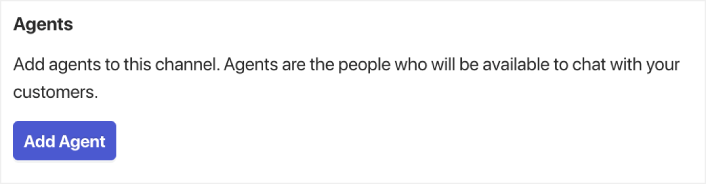
Each agent profile includes:
- Agent Name
- Agent Photo
- Designation (Sales, Support, Billing, etc.)
- Contact Preference (Live chat, WhatsApp, Email, etc.)
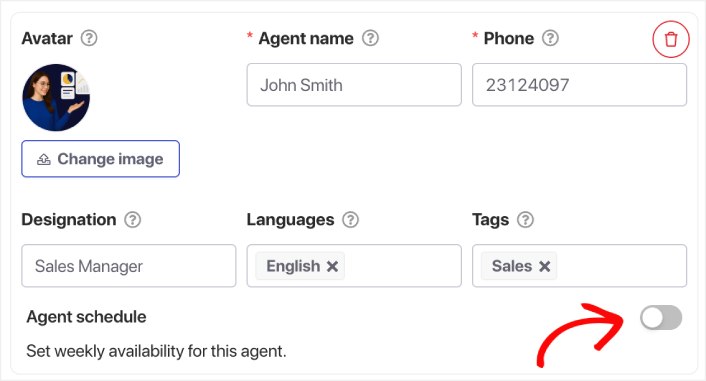
Under Languages, you can select all the languages your agent can communicate in.
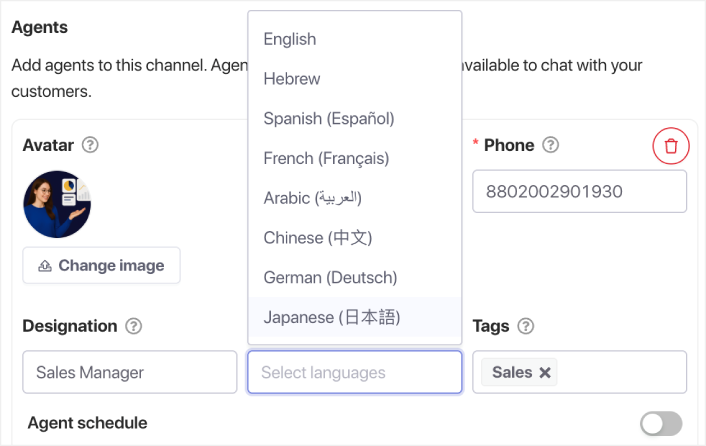
Of course, you can choose multiple languages for each agent.
Scroll down to the Agent Schedule section and turn on the toggle button.
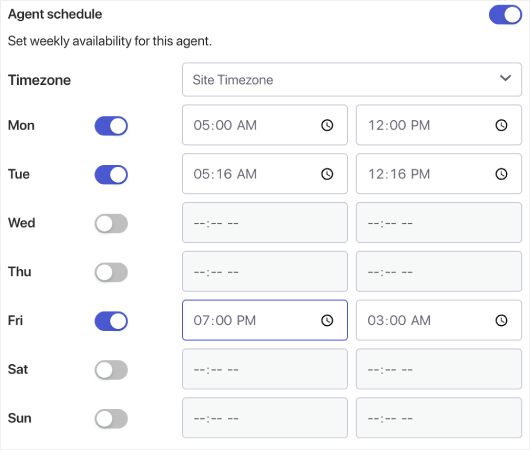
Select the agent’s current time zone, not yours.
Examples:
- IST for India
- EST or CST for US teams
- GMT or CET for European teams
This ensures their schedules activate at the right moment.
Step 3: Save and Repeat for All Agents
Once the schedule is set, click Save Agent. Repeat for each agent in each time zone to complete the coverage map.
Step 4: Add Country Targeting
Head over to the Triggers tab. Under Display Rules, click on Add Rule Group and select Countries option from the dropdown.
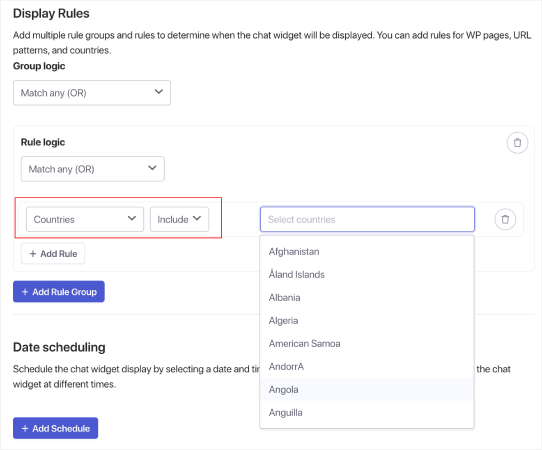
And select all the countries you want that chat to show up in.
Finally, save the widget and activate it. And you’re done!
Best Practices for Maximizing Global Coverage
✔ Create overlapping windows
Have at least 1–2 hours where two agents’ schedules overlap. This gives smoother handoff and reduces offline gaps.
✔ Add an Offline Fallback Message
This can be a lead form, email capture, or WhatsApp chat option.
✔ Assign roles based on time zones
- APAC agent handles sales for early zones
- EU agent handles general support
- US agent handles billing + late support
✔ Don’t try to force 24/7 manually
Smart scheduling looks natural; forced scheduling breaks trust.
✔ Review chat patterns
Check when visitors most frequently initiate chats and adjust schedules accordingly.
Set It Once, Cover Every Time Zone Automatically
Multilingual chat support isn’t just a nice-to-have — it’s essential for any business that attracts visitors from more than one region. With PushEngage, you can set up fully localized chat experiences in minutes, segment them by language or location, and deliver customer support that feels native and personal.
The result?
- More trust.
- More engagement.
- More conversions.
- A better experience for every visitor.
If you haven’t already set up agent profiles and schedules in PushEngage, now’s the time.
Not convinced? Check out these amazing resources on push notification campaigns:
- How to Increase Hotel Sales in Low Season
- How to Do Multichannel Marketing for Hotels in 2025
- How to Convert Subscribers To Buyers Using Web Push Notifications
- How to Notify Subscribers of New WordPress Posts
- How to Send Back-in-Stock Notifications to Get More Sales
- How to Clean Up Push Notifications Subscriber Lists (Easy)
- How to Automatically Send RSS Push Notifications
- How to Use Push Notifications to Promote a News Site
- How to Use Cross Selling Push Notifications to 2x Your Sales
- How to Use Browse Abandonment Push Notifications (4 Steps)


