Why Urgency Works: The Psychology Behind the Tactics
Urgency messaging isn’t a trick. It’s a description of reality — most inventory is genuinely limited, most discount codes do expire, and most price windows do close. When urgency messaging is accurate, it works because of three deeply human tendencies. Loss aversion. Kahneman and Tversky’s research established that losses feel roughly twice as painful as equivalent gains feel good. “You’ll lose this price” lands harder than “you’ll save money.” Cart recovery copy that frames inaction as loss — “your items are about to be released” — taps directly into this. Scarcity signals value. When something is limited, people want it more. A notification that tells a shopper only three units remain in their size doesn’t just create urgency — it validates their product choice. You chose something other people want. Decision deadlines eliminate procrastination. “I’ll come back later” is the cart abandonment loop. A clear deadline — “your saved cart expires tonight at midnight” — forces the decision now instead of indefinitely. The shopper either acts or consciously chooses not to. Both outcomes are better than the endless deferral that lives in most abandoned carts. FOMO (the fear of missing out) is the social layer on top of these three. When other shoppers are buying the same item, when it’s trending, when demand is visibly outstripping supply — FOMO accelerates the decision.The Six Urgency Tactics: How Each One Works
1. Countdown and Cart Expiry
Set a real window — typically 24 to 72 hours — and communicate it explicitly. The notification should state when the cart expires, not just that it “will” expire. Works well for: high-intent shoppers who abandoned due to distraction, not doubt. If they added to cart, they wanted the item. A deadline gives them permission to act. Backfires when: you reset the timer every time they revisit (they learn the deadline is fake), or you use countdown language on items with unlimited inventory. Push copy examples:“Your cart expires in 2 hours. 3 items waiting — complete your order before they’re gone.”
“Tasha, your bag is about to expire. Tap to save your picks.”
2. Low-Stock and Inventory Alerts
Real inventory scarcity is your strongest urgency signal because it’s verifiable. “Only 2 left in your size” is a fact you’re sharing, not pressure you’re manufacturing. Works well for: fashion, footwear, and any SKU with genuine scarcity at the variant level. Push copy examples:“Almost gone: the jacket in your cart is down to its last 2 in your size. Tap to lock it in.”
“Stock update: the Nike Air Max you saved — only 3 pairs left in US 10.”PushEngage’s back-in-stock and price-drop alert features share the same trigger infrastructure as cart recovery, so you can layer inventory signals into your recovery sequence without rebuilding from scratch.
3. Limited-Time Discount Urgency
Discounts with a genuine expiry are different from blanket sitewide sales. A code that expires in 3 hours tied to the shopper’s exact abandoned cart creates personal urgency — this offer is for you, and it’s leaving. Push copy examples:“We saved you 15% — but only until midnight. Your cart is waiting.”
“Your exclusive code expires in 3 hours: COMEBACK15. Complete your order now.”
4. Price-Drop Urgency
If a shopper abandoned and the price subsequently drops, that’s the highest-intent recovery trigger you have. They wanted it. They hesitated on price. Now the price moved. Push copy examples:“Price drop on your saved item — it just went from $89 to $67. Tap to grab it.”
“The headphones in your cart dropped $22. This price won’t last.”
5. Social Proof + Urgency
Combining social proof (other shoppers are buying this) with a scarcity signal creates double-layered urgency. It validates the product choice and accelerates the timeline simultaneously. Push copy examples:“47 people viewed this today. Only 4 left. Your cart is still saved.”
“This is trending right now — and your size is almost gone.”Use real data. If you’re pulling social proof signals, they should reflect actual behavior, not rounded-up guesses.
6. “Save Your Cart” Framing
Not every urgency message needs to be a countdown. “Save your cart” framing positions the notification as doing the shopper a favor — you’re preserving something they cared enough to build. This works especially well as a first touchpoint, before you escalate to scarcity and deadline language. Push copy examples:“We saved your cart so you don’t have to start over. 4 items waiting when you’re ready.”
“Your bag is ready — pick up where you left off.”This framing is lower pressure and higher trust. It respects the shopper’s decision-making pace while keeping you present. See more ready-to-use formats in the push notification examples library.
How to Sequence Urgency Across a Multi-Step Recovery Flow
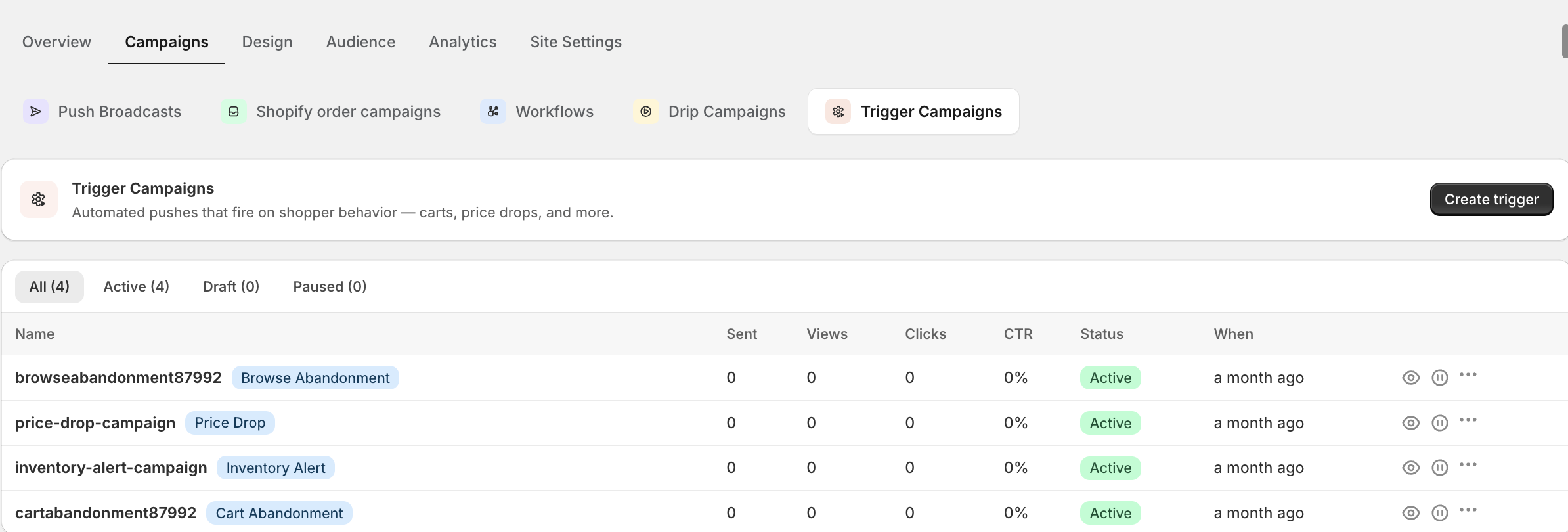
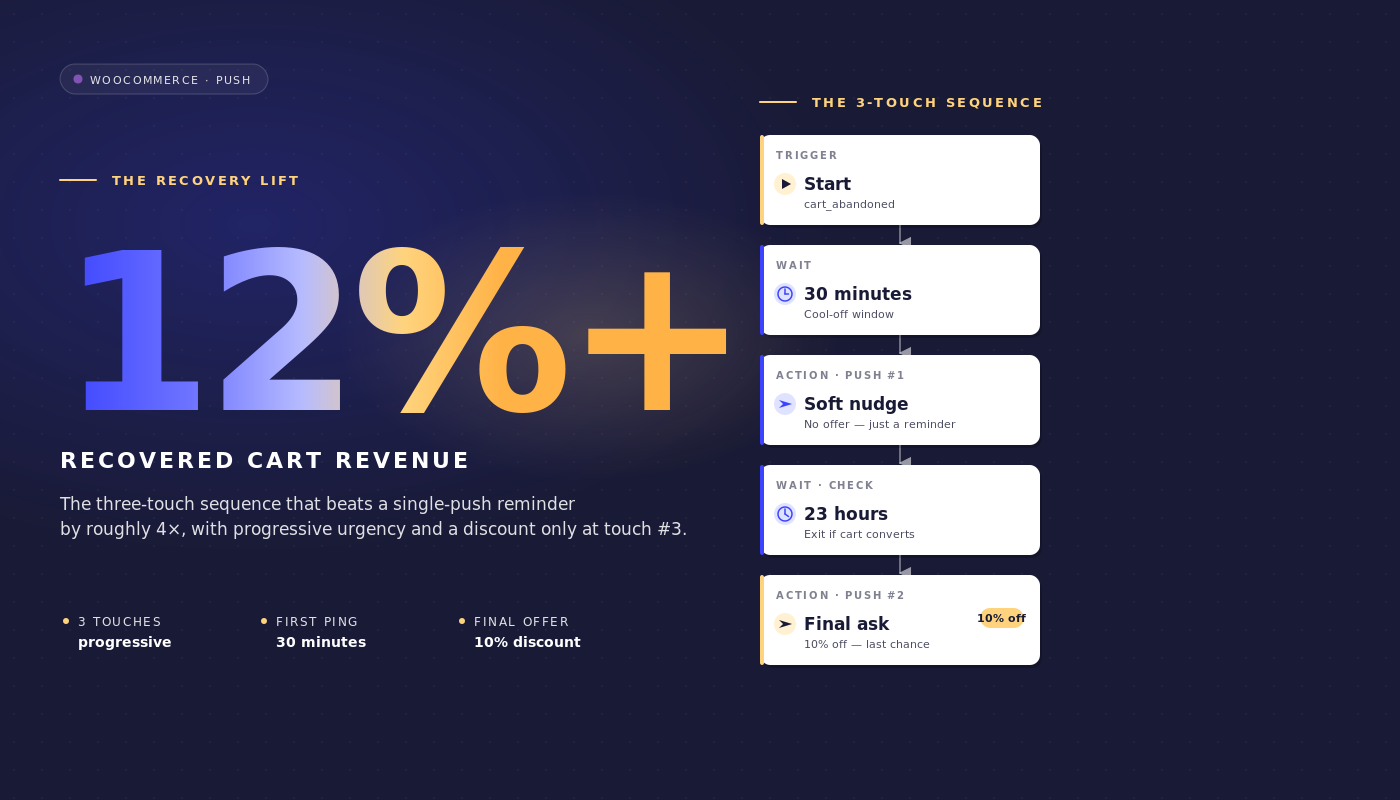
A single notification rarely closes the sale. A sequence that escalates intelligently — respecting the shopper’s timeline while building urgency over time — recovers far more revenue than any single message. Here’s a three-step sequence structure that works: Step 1 — 1 hour after abandonment: Gentle save Tone: helpful, no pressure. Goal: catch the impulse buyer who got distracted.“You left something behind. Your cart is saved and ready when you are.”No discount. No countdown. Just presence. The shopper who abandoned because their phone rang will convert here. Step 2 — 24 hours after abandonment: Social + scarcity signal Tone: informative, light urgency. Goal: bring back the hesitant shopper with a data point.
“Your cart is still saved — but these items are moving fast. 12 people viewed your saved products today.”Still no discount. You’re sharing real information, not manufacturing pressure. Step 3 — 72 hours after abandonment: Deadline + incentive Tone: direct urgency with a value reason to act now. Goal: close the fence-sitters.
“Last chance — your cart expires tonight. Use SAVE15 for 15% off. Offer ends at midnight.”This is where the discount lands, attached to a genuine expiry. Showing the multi-step sequence in action at the workflow level is covered in the multi-step cart abandonment recovery documentation. This three-step structure works on WooCommerce, Shopify, and custom stacks. If you’re running WooCommerce specifically, the WooCommerce cart abandonment push notification setup guide walks through the exact configuration. Shopify stores have their own native integration path — see what PushEngage can do for Shopify stores.
Web Push vs. Email: Why Channel Speed Matters for Urgency
Urgency messaging only works if it arrives while the urgency is real. That’s the core argument for web push as your primary cart recovery channel. Email’s average open time is measured in hours, sometimes days. If you send a “cart expires in 2 hours” email and the shopper opens it four hours later, you’ve either lied or you’ve lost them. Most brands end up either extending the deadline (teaching shoppers the clock is fake) or sending the same email again (training them to ignore the sequence). Web push arrives in seconds. The notification appears on the device before the shopper has even loaded a new page. Your 2-hour cart expiry message lands when the 2 hours are actually counting down. That’s not a channel advantage — it’s what makes the urgency credible. For shoppers who haven’t opted in to web push, or who are deep in the purchase journey via mobile app, you can extend the same recovery sequences across app push and WhatsApp. Recovering abandoned carts via WhatsApp covers how to run the same urgency logic without the per-message costs that make WhatsApp cart recovery prohibitively expensive on most platforms. Running multi-channel recovery — web push first, then WhatsApp for non-converters — is the strategy covered in multi-channel customer engagement for eCommerce. Web push leads. Other channels fill the gaps.
Measuring Effectiveness and Avoiding Urgency Fatigue
Running urgency sequences without measurement is guesswork. Three metrics to track at minimum: Recovery rate. What percentage of abandoned carts result in a completed purchase after the recovery sequence runs? This is your headline number. Benchmark it before and after adding urgency elements to isolate the lift from urgency specifically. Click-through rate (CTR) by step. Which step in your sequence drives the most clicks? If Step 1 (gentle save) has a 12% CTR and Step 3 (deadline + discount) has a 3% CTR, that tells you where your high-intent abandoners live and where you’re burning budget on fence-sitters who won’t convert regardless. Conversion rate after click. A high CTR on a discount notification that converts at 8% is still valuable — but it tells you the discount is doing the work, not the urgency. That matters for margin math. Avoiding urgency fatigue: Urgency fatigue is what happens when every notification from your store sounds like the last one. Shoppers learn to discount (literally) everything you send. Signs you’re in urgency fatigue territory:- CTR on cart recovery notifications declining over 8–12 weeks without a change in abandonment volume
- Unsubscribe rate spiking after high-frequency recovery periods (Black Friday, etc.)
- Discount conversion rate increasing while recovery rate stays flat (shoppers waiting for the discount, not responding to urgency)