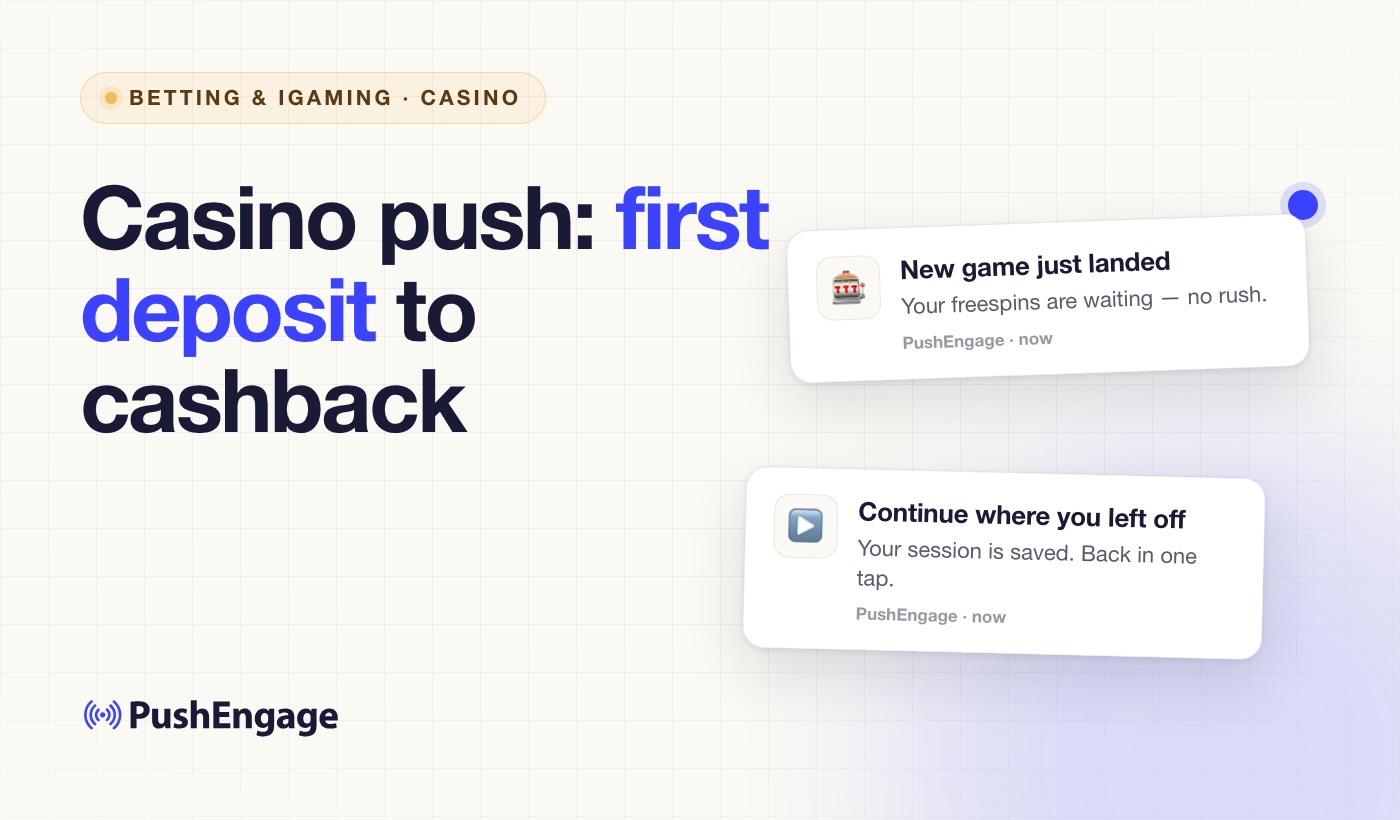
Your colleague on the sportsbook side gets a content calendar for free. Fixtures, kickoffs, settlement moments, derby weeks: the sport writes the send schedule, and the CRM team executes it. You run the casino vertical, and no league publishes your schedule. That difference decides everything about how casino push notifications work. There is no external event to anchor a send to, so your own cadence is the calendar, and the operators who win with push are the ones who design that cadence deliberately instead of blasting the lobby at random.
This post covers the full casino lifecycle on push: the first-deposit workflow, the continue-where-you-left-off triggers that resume abandoned sessions and cashier visits, the engine of new-game launches, free-spin drops, and jackpot alerts, the weekly cashback rhythm, and the responsible-gambling suppression rules that make it all sustainable. Two blueprints are written as builder steps you can rebuild today.
Why casino push notifications run on a calendar you build
Betting and gaming sites on PushEngage have sent over 3.5 billion notifications, and the clearest pattern in that volume is targeting discipline: the median betting-site sender sees ~2.1% CTR on viewed notifications; the top decile does 6.9% — roughly triple. The top decile is not sending more. It is sending to players whose behavior asked for the message.
For a casino, that discipline has to be manufactured. A sportsbook borrows relevance from the fixture list; if you run sports betting push notifications, the match itself makes the send timely. A casino builds relevance from four rhythms it controls: new-game launches, free-spin drops, jackpot alerts, and a fixed weekly cashback. Everything else in this post hangs off those four, plus two lifecycle workflows that run underneath them.
The stakes for getting cadence wrong went up in January 2026, when Chrome began scoring every sending origin daily on notification volume relative to time users actually spend on your site. An undisciplined casino calendar now degrades deliverability for every campaign you run. The retention playbook for the wider vertical is covered in our pillar on push notifications for betting sites; this post is the casino-specific build.
The casino lifecycle map behind iGaming push notifications
Casino behavior follows a recognizable arc, and each stage has one push motion that fits it. The arc: onboard, form a game and provider preference, settle into a session habit, join the weekly bonus rhythm, progress through VIP tiers, and eventually lapse. Session recency is the master variable across all of it. iGaming push notifications succeed or fail on whether they respect which stage the player is actually in.
| Lifecycle stage | What the player is doing | The push that fits |
|---|---|---|
| Onboard | Registered, exploring the lobby, no deposit yet | First-deposit workflow (below) |
| Preference forming | Settling on providers and titles | New-game launches to that provider’s segment |
| Session habit | Regular sessions, usually evenings | Free-spin drops, jackpot alerts |
| Bonus rhythm | Claims the weekly cashback | Fixed Monday cashback push |
| VIP progression | Climbing tiers | Milestone perks, wager-free spins |
| Lapsing (7–21+ days idle) | Drifting away | One lobby-refresh nudge, then reduced frequency |
The lapse stage is where casinos quietly bleed. In one 90-day window, unsubscribes erased roughly 91% of new subscriber acquisition across the segment. That is the leaky bucket iGaming push notifications either fix or accelerate: lifecycle-fit sends compound the list; blasting the dormant majority drains it faster than acquisition refills it. And segmentation is now a deliverability requirement, not a nice-to-have.
The first deposit conversion workflow: patient by design
The gap between registration and first deposit is where casino operators lose the most paid acquisition. You paid full CAC for the registration; until the deposit lands, that spend has recovered nothing. First deposit conversion is therefore the first workflow to build, and the counterintuitive part is its temperament: it works patiently, because one rule is absolute. No urgency framing on deposit prompts, ever. The bonus is presented as available, not expiring. Countdown pressure on depositing money is both an ethics failure and prime territory for the on-device ML spam warnings Chrome has run on Android since May 2025; the trust practice and the deliverability practice are the same practice.
Here is the blueprint as PushEngage Workflows steps. Audience: segment registered AND attribute deposit_tier = none (your platform sets both via API at signup). Quiet hours 00:00–09:00, fallback reschedule.
- START — audience trigger as above.
- SEND PUSH — “Your welcome bonus is ready” / “100% match on your first deposit. Claim whenever you’re ready.”
- WAIT — 2 days.
- DECISION — is
deposit_tierstillnone? No → END (they deposited; the weekly rhythm takes over). Yes → step 5. - SEND PUSH — switch from offer to clarity: “See how the welcome bonus works” / “Deposit $50, play with $100. Full terms, no surprises.”
- WAIT — 3 days.
- DECISION — still no deposit? No → END. Yes → step 8.
- SEND PUSH — switch from bonus to product: “This weekend’s lobby is live” / “Three new titles this week. Your welcome bonus stays available.” Then END.
The exit criterion is the point: any change to deposit_tier ends the sequence wherever the player is in it. The deposit itself is the exit. Three touches over five days is the ceiling; a non-depositor drip that never ends is exactly the low-engagement, high-volume profile that erodes your origin score. After touch three, the player simply joins your normal content cadence.
Plan gating: the wait and decision nodes above run on Business plans and up. On Growth, build it event-triggered instead — registration_completed starts the workflow and deposit_completed exits it — so first deposit conversion runs off real funnel events rather than attribute polling.
Continue where you left off: the cart abandonment of gaming
E-commerce push has a proven top performer: the cart abandonment push sequence. Gaming has an exact equivalent, aimed at the highest-intent audience you have — players who were mid-action minutes ago. Your platform fires a custom event at the abandonment moments it can see: game_session_ended (session closed with balance remaining) and deposit_abandoned (cashier opened, not completed). One workflow per event; custom-event triggers run on Growth plans and up, and this family of workflows is the best argument for them.
The session-resume blueprint. Run type: Multiple Parallel. Quiet hours 00:00–09:00, fallback skip — a resume nudge nine hours later is noise, not service.
- START — event trigger: CustomEvent where
event_name = game_session_ended. - WAIT — 45 minutes. Inside the intent window, but not so fast the player feels watched.
- DECISION — has
last_session_atupdated since the event? Yes → END (they came back on their own). No → step 4. - SEND PUSH — personalized on the title: “Sweet Bonanza, right where you left it” / “Your session is saved. Jump back in whenever you like.” Deep-link straight to the game. Then END.
Cap the whole continue-where-you-left-off family at one resume push per player per day. These sends are also deliverability insurance: they go only to players active minutes ago, so every send strengthens your origin’s engagement profile.
The abandoned deposit rule: no sweetener, no countdown
The deposit_abandoned branch gets stricter treatment, and this is a house rule worth adopting verbatim: an abandoned deposit is sometimes a player deciding not to deposit, and that decision is respected. Send one neutral resume push — “Pick up where you left off” / “Your cashier session is saved exactly as you left it. Back in one tap.” — with no bonus attached and no countdown. If they do not return, the sequence ends. Sweetening an abandoned deposit teaches players that hesitation gets rewarded, and it edges the message from service into pressure.
New games, free spins, and jackpots: the online casino marketing engine
Between the lifecycle workflows sits the content engine — the sends that fill the calendar you are building. In online casino marketing, three formats carry nearly all of the weight: new-game launches sent to players who favor that provider, free-spin drops as the weekly currency, and jackpot alerts as the spike events. A fourth, the seven-day-idle lobby refresh, catches players drifting toward lapse. Note the one place countdown copy is legitimate: a free-spin expiry genuinely expires, so stating the deadline is fact, not manufactured pressure.
| Trigger moment | Público | Title (≤50 chars) | Body (≤100 chars) |
|---|---|---|---|
| New game launch | Provider-preference segment | New Pragmatic release is live | Just landed in the lobby. 50 free spins on your first session today. |
| Free-spin drop | Slots-active players | Your 50 free spins are ready | Valid on Sweet Bonanza until midnight tonight. Spin them before they expire. |
| Jackpot alert | Jackpot-format players | Jackpot alert: the Grand is climbing | One spin decides who takes it. See the live total in the lobby. |
| 7-day idle | Lapsing segment | New in the lobby since your last visit | Three new titles landed this week. Your VIP points are right where you left them. |
| Weekly cashback | Prior-week depositors | Your Monday cashback is in | Last week’s loss-back is credited. Claim it in your bonus wallet. |
| VIP milestone | Tier-upgrade event | Welcome to Gold VIP | Tier upgraded. Higher limits, weekly wager-free spins, faster withdrawals. |
Two craft notes. First, launch copy is testable: a freespin-led variant against a novelty-led variant (“Gates of Olympus has company — the new title is live in the lobby”) in a split-path workflow settles your launch formula quickly; split-path A/B testing runs on Premium plans and up. Second, online casino marketing lives or dies on provider-preference segments. A Pragmatic launch sent to the whole list is a blast; sent to pragmatic-fan, it is a service.
The weekly cashback rhythm that anchors casino player retention
Every casino market has a retention anchor, and it is almost always the same one: the fixed weekly cashback or loss-back, credited Monday. The operative word is fixed. It runs as a scheduled rhythm to everyone eligible, and never as a reactive send after a losing session. A Monday cashback push is a habit players plan around; a cashback push fired minutes after a losing streak is loss-chasing bait, and the difference between them is the entire integrity of your casino player retention program.
The mini-blueprint, scheduled every Monday at 10:00 (Business plans and up): audience trigger on cashback_eligible = true AND segment active-30d → send the cashback push → wait 8 hours → decision on cashback_claimed → if claimed, add the player to a bonus-responsive segment that feeds future offer targeting; if not, send one evening reminder and end.
Watch the claim rate week over week — it is the pulse of casino player retention. Falling claim rate with stable delivery means offer fatigue, not channel fatigue, and the fix is the offer, not more sends.
Responsible gambling rules that keep notifications turned on
Responsible gambling discipline is a commercial trust practice, not a legal checkbox (and nothing here is legal advice). Burned-out players churn, complain, and unsubscribe, and complaint signals now feed the same platform-reputation systems that score your origin. Four commitments, all implementable in PushEngage today:
- Self-exclusion is hard suppression, fast. When a player self-excludes, an API call moves them into a
self-excludedsegment within 48 hours — the strictest regulated markets require removal from all marketing within two days. That segment is excluded from every audience, and the segment-change event triggers a housekeeping workflow that stops their active workflows. Never send a “your exclusion has ended” win-back; re-entry must be the player’s own act. - No bonus pushes at loss-chasing signals. If your platform flags chasing patterns, feed the flag to PushEngage as an attribute and gate every bonus workflow with a decision node:
chasing_flag = true → EXIT. - No urgency framing on deposit prompts. Stated above; it bears repeating as policy, not preference.
- Quiet hours, frequency caps, instant opt-out. Default quiet hours protect sleep; per-player caps protect the relationship.
Operators who adopt all four give players something rare in this vertical: a reason to leave notifications on. In a market where responsible gambling standards are converging across regulated jurisdictions, the suppression architecture is also a durable competitive position.
Start with two workflows and one weekly rhythm
You do not need sixty campaigns to make casino push notifications pay. Build in this order: the first-deposit workflow (it recovers acquisition spend already committed), one continue-where-you-left-off event (start with game_session_ended), and the fixed Monday cashback. Layer the launch and free-spin engine on top once those three are live, and let the responsible-gambling gates run underneath everything.
PushEngage ships the workflow builder, behavioral segments, and per-notification revenue attribution this playbook assumes — see web push notifications for the channel details and pricing for plans; every paid plan carries a 14-day money-back guarantee. Start with the two workflows, measure deposit exits and claim rates rather than clicks, and your cadence stops being a blast schedule and starts being the calendar your players plan around.


