PushEngage vs Pushwoosh:
which one fits a mid-market store’s journeys?
Pushwoosh is a customer engagement platform billed per 1,000 monthly active users, with push, in-app, email, SMS, and WhatsApp in one journey builder. PushEngage is web push, app push, in-app, WhatsApp, and chat billed on active subscribers, with Workflows that wait, branch on clicks, and A/B test split paths. Here is where each one wins.
75,000+ businesses Prices published for every self-serve tier 14-day money-back guarantee
Reliability and trust
What a retention team needs before it switches tools.
A new vendor still has to pass the security review and the budget meeting. Here is what you can check today, without a sales call.



Prices you can put in the budget today
Every public tier is on the pricing page, billed on active subscribers, web and app combined. The number in the proposal is the number on the invoice.
- Published tiers from 1,000 to 250,000 subscribers
- No per-message fees on push; each plan includes a monthly sending volume
- Inactive Subscriber Cleanup on every plan
- Enterprise quoted above 250,000
Send controls that protect the channel
Browsers now throttle senders who over-message. Cap how often each subscriber hears from a triggered campaign and send in their timezone.
- Daily and weekly frequency caps on triggered campaigns, Growth and above
- Quiet hours inside Workflows
- Subscriber-timezone sending on Premium and above
GDPR and CCPA in the defaults
Every subscription is a browser or device permission grant. Add a pre-permission consent overlay where your audience needs one.
- Configurable pre-permission overlay per site
- One-click unsubscribe at the device level
A dashboard for marketers, an API for engineers
Your team runs campaigns and Workflows from the dashboard. When you would rather hand it off, an MCP server lets Claude or Cursor work the account.
- AI Copywriter through AI-powered campaigns, a paid credit add-on on Business, Premium, and Growth (included on Enterprise)
- First-party MCP server for Claude, Claude Code, and Cursor
- REST API, SDKs, and Zapier on every plan, webhooks on Growth
- Open-source Agent Skills for SDK integration
Support that scales with the plan
Email support on every paid plan. Growth and Enterprise add direct access to customer success and onboarding with your first campaign set up for you, and Enterprise gets a technical onboarding contact.
A 14-day money-back guarantee
Over the next 14 days, if PushEngage isn’t the best fit, simply reach out. We’ll refund 100% of your money. No questions asked.
Built by Awesome Motive, the team behind WPForms, AIOSEO, OptinMonster, and MonsterInsights.
Trusted by 75,000+ businesses








The 30-second version
Two different meters, two different jobs.
Pushwoosh is built to message app and web users on every channel from one journey builder. PushEngage is built to run the retention channels a marketing team owns, with A/B push journeys, at a price tied to its push audience. Pick on the job, not on the logo.
Your store runs on WordPress, WooCommerce, or Shopify
Install the plugin, design the opt-in prompt in the dashboard, and web push is live. Pushwoosh web push starts with its SDK files and a service worker at your site root, or a theme embed on Shopify.
You want A/B push journeys at a subscriber price
Wait, Decision, and Split Path all run on Premium, priced on active subscribers. At 50,000 subscribers that is $2,566 a year at standard annual renewal.
Email, SMS, and WhatsApp in the same journey
Pushwoosh journeys mix push, in-app, email, SMS, WhatsApp, LINE, Kakao, and Telegram on one plan. PushEngage Workflows send web push and app push; it does not send email or SMS.
Deeper testing and timing inside journeys
A/B/n splits that pick a winner by goal, waits that branch on events, holdout groups, and a per-user best time to send. PushEngage picks Split Path winners by hand and sends in each subscriber’s timezone.
Side by side
Pushwoosh and PushEngage, row by row.
Every Pushwoosh cell comes from Pushwoosh’s own pricing page and documentation, checked on October 5, 2026. Where Pushwoosh is stronger, the table says so.
| Pushwoosh | PushEngage | |
|---|---|---|
| How it describes itself | A “customer engagement platform” for push, email, and in-app (its homepage title), with an actionable CDP and ManyMoney AI, positioned for mobile-first businesses in gaming, fintech, mobility, media, subscription apps, and eCommerce. | Web push, app push, in-app, WhatsApp, and a chat widget for marketing teams at eCommerce stores, publishers, and SaaS products that want retention channels without an engineering queue. |
| Published prices | Yes. Per 1,000 monthly active users: $13 on its “Omnichannel” plan (every channel) and $7 on Push only (mobile push, in-app, web push), a limited offer for sign-ups by December 31, 2026, locked for 24 months. Email only is $5 per 1,000 recipients. The first 1,000 MAU are free. Above $3,000 a month, a custom plan. | Yes, every public tier. Free, Business, Premium, and Growth are priced on /pricing/, up to 250,000 subscribers. Enterprise is quoted. |
| What the bill is based on | Monthly active users. Its metrics glossary defines MAU as unique users who opened the app in a calendar month, the count billing uses. Its pricing FAQ adds that anyone who receives a message on any channel counts, deduplicated by User ID. On Push only, an MAU is a unique person you messaged by push, in-app, or web push that month. | Active subscribers on a fixed tier, web and app combined. No per-message fees on push; each plan includes a monthly sending volume (40, 50, or 75 times your subscriber count on Business, Premium, and Growth). Inactive Subscriber Cleanup keeps dormant devices off the bill. |
| Free plan | Free up to 1,000 MAU, with every feature included. Pushwoosh says there is no feature gating on any plan. | Free for 1 site or app, 200 subscribers, and 30 campaigns, with 1 active workflow. No trial on paid plans; a 14-day money-back guarantee instead. Money-back guarantee |
| Channels | Mobile push, in-app, web push, email, SMS, WhatsApp, Kakao Talk, Telegram, and LINE on the “Omnichannel” plan, with Viber, Facebook Messenger, app inbox, web popups, and Apple and Google Wallet passes in its docs. Push only covers mobile push, in-app, and web push. Broader | Web push, app push, in-app messaging on every plan, with usage limits by plan (live, Android SDK first, more SDKs to follow), WhatsApp automation through your own Meta Business account (order updates on paid plans, cart recovery from Growth), and a chat widget with 21 channels plus custom links. No email or SMS sending. |
| Journey builder | Customer Journey Builder on every plan: trigger, audience, or API entry, Time Delay (up to 30 days), Wait for Trigger (branch on events within up to 90 days), Condition Split, Reachability check, Holdout Split, Loop, Webhook, and Update user profile steps, with email, SMS, and messenger steps beside push. Deeper | Workflows on every plan. Free: 1 active workflow of up to 5 steps. Business: 5 active workflows, 10 steps, with Wait, Decision, and Exit steps. Premium: 20 active workflows, 25 steps, adding Split Path and Workflow Chaining. Growth: unlimited workflows and steps, adding HTTP request actions. Subscribe, segment change, and field update triggers on every plan. Send steps deliver web push and app push. |
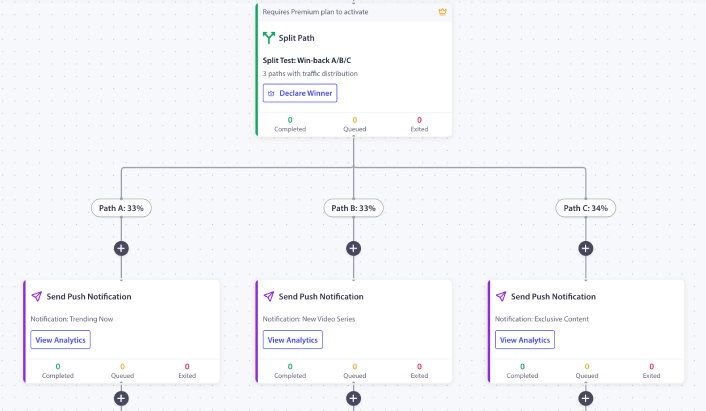
| A/B testing inside journeys | A/B/n Split with up to four branches and percentage routing. The winner is picked by hand or automatically by conversion goal once the result is statistically significant. A Multi-Armed Bandit push step (marked experimental) shifts traffic to the variant opened most. Automatic winner | Split Path on Premium and above: two or more paths with percentage routing, completed, queued, and exited counts per path, and a Declare Winner button that sends every new entrant down the path you pick. Campaign A/B tests (Premium and above) send the better click-through rate to everyone else after a sample and delay you set. |
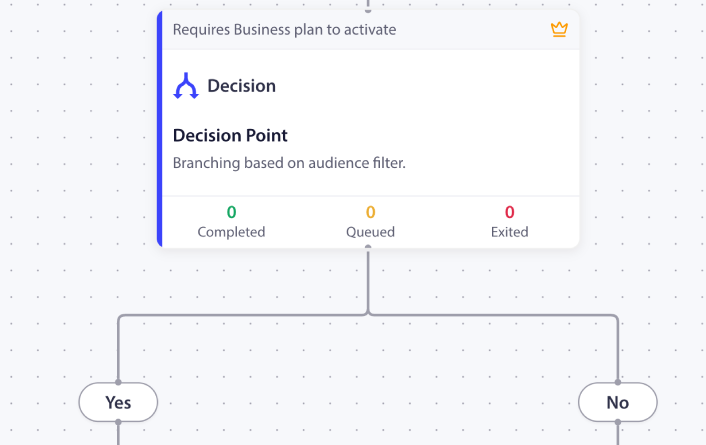
| Branching on behavior | Wait for Trigger branches on whether a user opens the push, clicks a link, or buys within a time window, up to three branches plus Not triggered. Condition Split branches by segment, tag, or event attribute. | Decision steps (Business and above) send each subscriber down Yes or No on an audience filter, such as last click date, total clicks, segments, attributes, or location, or on the trigger event’s data. Exit steps end the journey early. |
| Send-time optimization | Best time to send in the push step picks a time per user from their behavior and past message performance, within 24 hours; users without enough data get a default time in their timezone. Per-user timing | Partly. Subscriber-timezone sending on Premium and above: you pick the hour and each subscriber gets the campaign at that hour on their own clock. You can A/B test send time, for example with a Split Path that waits longer on one branch. No per-subscriber send-time prediction. |
| Frequency and quiet hours | Global frequency capping per channel (up to a 30-day window), custom caps per message, send-rate limits, a Silence period per journey in each device’s timezone, and campaign entry limits. | Quiet hours per workflow, in the subscriber’s timezone, that skip or reschedule a send. Run-once or repeat entry rules per workflow. Daily and weekly frequency caps on triggered campaigns (Growth and above). |
| Funnels and journey analytics | Statistics on every journey step, conversion goals credited to the message step that influenced them, a path finder for one user inside a journey, user retention statistics, and dashboards. Its statistics API returns a delivery funnel per message. Deeper | No funnel or path reports. Workflow analytics count completed, queued, and exited subscribers at every step, and goal tracking on Premium and above ties orders, signups, and revenue to the campaign or workflow that drove them. |
| Opt-in tracking | A Subscription widget (a prompt plus a launcher bell) for web push, an iOS push primer before the system prompt, iOS provisional push, and separate counts of Push Enabled and Push Alerts Enabled devices, per its docs. | On the web, opt-in conversion metrics (Premium and above) report the custom prompt and the browser’s native prompt as separate steps, with allow, block, and close counts. Smart Opt-in Reminder and targeted opt-in triggers on every plan. In apps, an in-app message can carry a request-permission button, with impression and button-click counts (Android SDK first). No provisional-authorization segment. |
| Web on-site popups | Web popups: on-site overlays for promotions, welcome offers, and lead capture, targeted by segment, page, delay, and frequency once its Web Push SDK is on the site. Yes | No promotional popups for websites. PushEngage popups on your site are push opt-in prompts, and the chat widget runs on your site. In-app messages run inside mobile apps. |
| Web push setup | Download the Web Push SDK, host pushwoosh-service-worker.js at your site root, and add the init script with your application code, or use Google Tag Manager. On Shopify, a theme embed collects opt-ins. Its pricing FAQ puts SDK integration, user import, and first subscribers at 2 to 10 days. | Plugins for WordPress, WooCommerce, and Shopify. On any other site, add our JavaScript and a service worker file at your site root, once. A no-code opt-in prompt builder in the dashboard. No developer on WordPress or Shopify |
| eCommerce platforms | A Shopify app that syncs customers, orders, carts, checkout steps, product views, and add-to-cart events, with Shopify Flow actions, plus a Magento 2 integration. Its integrations page lists these two under e-commerce platforms. | A Shopify and Shopify Plus app and a WordPress and WooCommerce plugin, with ready cart abandonment, browse abandonment, price drop, and back-in-stock campaigns on Growth. |
| SDKs | iOS, Android (with Huawei and Amazon), Web, Windows, and macOS, plus React Native, Flutter, Cordova, Capacitor, Expo, Unity, MAUI .NET, OutSystems, and Mendix. Broader | Web, iOS, Android, Flutter, and React Native, all five on every plan, with the REST API and Zapier. Webhooks on Growth. |
| AI and agents | ManyMoney AI (labeled beta in its docs) on every plan with daily request limits, an MCP server for Claude Desktop and Cursor, a Messaging MCP for sending, and AI Composer for push copy. | AI Copywriter through AI-powered campaigns, a paid credit add-on on Business, Premium, and Growth (included on Enterprise). A first-party MCP server for Claude and Cursor on every plan, including Free. |
| Support, contract, and security | Pay-as-you-go. Past $3,000 a month in estimated cost, a custom plan with dedicated support, SLA guarantees, and volume discounts. ISO 27001:2022 certified, SOC 2 Type 2 audited, and HIPAA compliant, per its pricing FAQ. | Pay monthly or yearly, with a 14-day money-back guarantee on paid plans. Email support on Business and Premium. Email plus direct customer-success access, and onboarding with your first campaign set up, on Growth and Enterprise. Enterprise gets a technical onboarding contact. GDPR and CCPA tooling and a pre-permission consent overlay. |
Pushwoosh details checked on pushwoosh.com/pricing and the Pushwoosh documentation on October 5, 2026. Pushwoosh MAU and PushEngage subscribers are different counts, so the price rows are not like-for-like. Features and packaging change, so confirm with Pushwoosh before you buy. PushEngage details are from the live pricing page, the Workflows page, and the developer hub.
Worked example
A multi-step push journey with A/B split paths, built in PushEngage.
This is the question mid-market stores bring to a Pushwoosh comparison: can the tool run an automated, multi-step push journey with A/B split paths? In PushEngage Workflows it takes five steps on one canvas. Here they are in plain words, with the plan each one needs.
-
1
Trigger: a shopper joins a segment
Every planPick the segment that starts the journey, for example the repeat-buyer list you build for a spring sale. Segment change, new subscriber, and field update are event triggers on every plan, so each shopper enters the moment they qualify.
-
2
Wait: one day, sent at 10 AM their time
Business and above (subscriber timezone on Premium)A Wait step holds each shopper for a set time, or until a set hour in the subscriber’s own timezone. Workflow quiet hours skip or reschedule anything that would land overnight.
-
3
Decision: did they click recently?
Business and aboveA Decision step checks each shopper against an audience filter, here “last click date in the last 7 days”. Engaged shoppers go to the test. The rest take the No branch to an Exit, or, on Premium, start a separate win-back workflow through Workflow Chaining.
-
4
Split Path: A/B test the offer
Premium and aboveSplit the engaged shoppers by percentage, say 50/50: path A gets “Free shipping today”, path B gets “Early access to the sale”. Each path shows its own completed, queued, and exited counts. When one wins, Declare Winner sends every new entrant down that path.
-
5
Action: send the push
Every planA Send Push Notification step on each path delivers to web push and app push subscribers on the same profile, with name and attribute merge tags. With goal tracking (Premium and above), orders and revenue are credited to the workflow.
Which plan runs it
The whole journey runs on Premium: 20 active workflows, up to 25 steps each. On Business you can build steps 1, 2, 3, and 5; the Split Path needs Premium. Adding an HTTP request to your CRM or firing a custom event needs Growth. Pushwoosh builds the same journey with Trigger-based entry, Time Delay, Wait for Trigger or Condition Split, A/B/n Split, and a Push step, on every plan, and can add email, SMS, or WhatsApp steps on its “Omnichannel” plan. See how Workflows work.
Pricing
Both publish prices. The meters differ.
Pushwoosh prices per 1,000 monthly active users each month. PushEngage prices by active subscribers, shown here at the standard annual renewal rate you pay from year two. A Pushwoosh MAU and a PushEngage subscriber are different counts, so read the figures as a range, not a like-for-like quote. First-year pricing is lower, from $8 a month billed yearly.
The growing store
20,000 people a month: Pushwoosh MAU, or PushEngage active subscribers
$133/mo listed, × 12; offer for sign-ups by Dec 31, 2026$1,596/yr
$247/mo listed, × 12; adds email, SMS, WhatsApp$2,964/yr
lowest plan with Split Path, standard annual renewal$1,458/yr
adds cart, browse, price drop, back in stock$1,828/yr
Pushwoosh Push only counts people you message that month. PushEngage counts active subscribers. Check both numbers for your own list.
The established brand
50,000 people a month: Pushwoosh MAU, or PushEngage active subscribers
$343/mo listed, × 12; offer for sign-ups by Dec 31, 2026$4,116/yr
$637/mo listed, × 12; adds email, SMS, WhatsApp$7,644/yr
lowest plan with Split Path, standard annual renewal$2,566/yr
adds cart, browse, price drop, back in stock$3,489/yr
Premium covers 2 sites and 100,000 subscribers. Growth adds cart, browse, price drop, and back-in-stock campaigns.
The multi-site retailer
100,000 people a month: Pushwoosh MAU, or PushEngage active subscribers
$693/mo listed, × 12; offer for sign-ups by Dec 31, 2026$8,316/yr
$1,287/mo listed, × 12; adds email, SMS, WhatsApp$15,444/yr
lowest plan with Split Path, standard annual renewal$4,412/yr
adds cart, browse, price drop, back in stock$6,258/yr
Above 100,000 subscribers PushEngage moves to Growth. Pushwoosh moves to a custom plan once the estimate passes $3,000 a month.
Pushwoosh figures use its pricing calculator on October 5, 2026: the first 1,000 MAU free, then $7 (Push only) or $13 (“Omnichannel”) per 1,000 MAU a month, times 12, before taxes. Push only is a limited offer for sign-ups by December 31, 2026, with the price locked for 24 months. PushEngage prices are the standard annual renewal rate from the live plans API on the same day, taxes excluded. Each plan includes a monthly sending volume. The pricing page has the calculator and the current first-year offer.
Where we will not pretend
Five things a fair Pushwoosh comparison says out loud.
- Pushwoosh covers more channels. Email, SMS, WhatsApp, LINE, Kakao, Telegram, Viber, wallet passes, app inbox, and web popups are real capabilities, and its journeys can mix them. PushEngage sends web push, app push, in-app, and WhatsApp automation, and does not send email or SMS.
- Its journey builder goes deeper. A/B/n splits that pick a winner automatically by goal, Wait for Trigger branches, Holdout Split, Loop, Reachability check, and a Multi-Armed Bandit push step, with no feature gating by plan. PushEngage gates Split Path to Premium and you declare the winner yourself.
- Pushwoosh predicts and charts more. Best time to send picks a send time per user, journey statistics credit conversions to each step, and web popups run offers on your site. PushEngage sends at the hour you choose in each subscriber’s timezone, reports conversions through goal tracking, and has no funnel reports or website popups beyond its opt-in prompts.
- The meters are not the same. A Pushwoosh MAU is someone who opened your app or received a message that month. A PushEngage subscriber is someone who opted in to push. Check both counts for your own list before you compare the lines above.
- Two tools can be the right answer. Keeping Pushwoosh for email, SMS, or a mobile app journey and running web push and Workflows in PushEngage is a valid setup. If you do that, cap frequency in both.
What the published price includes
Everything a push program needs, run from one dashboard.
Every paid tier includes web and app push on one subscriber profile, Workflows, behavior-based segmentation, and Inactive Subscriber Cleanup. Premium adds Split Path, goal tracking, A/B tests, and timezone sending. Growth adds triggered campaigns with frequency caps and the eCommerce automations.

One composer for the browser and the lock screen
Write it once and send it to Chrome, Firefox, Edge, and Safari, and to iOS and Android, from the same screen. One audience, one report.
- Native SDKs for iOS, Android, React Native, and Flutter on every plan
- Live preview per platform, plus AI-powered campaigns, a paid credit add-on (included on Enterprise)
- Scheduling and recurring sends, with timezone delivery on Premium and above
eCommerce automations you switch on
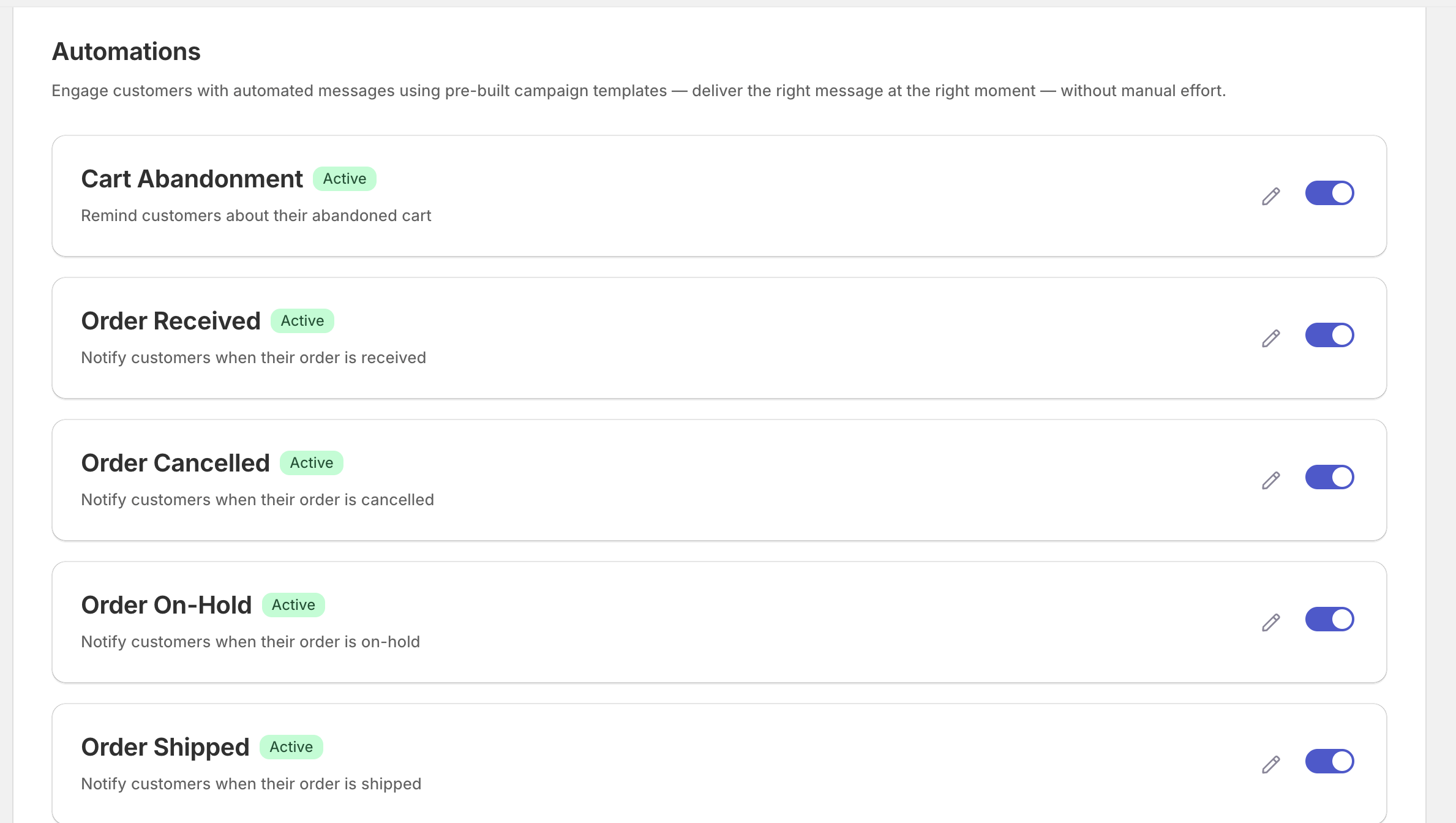
Order received, on hold, cancelled, shipped, plus cart abandonment. Each is a ready campaign behind a toggle, and each reports the revenue it brought back.
- Cart and browse abandonment, price drop, and back in stock on Growth
- Order and shipping updates that answer where-is-my-order before the ticket
- Goal tracking on Premium and above ties revenue to the campaign that earned it
Workflows: wait, decide, act
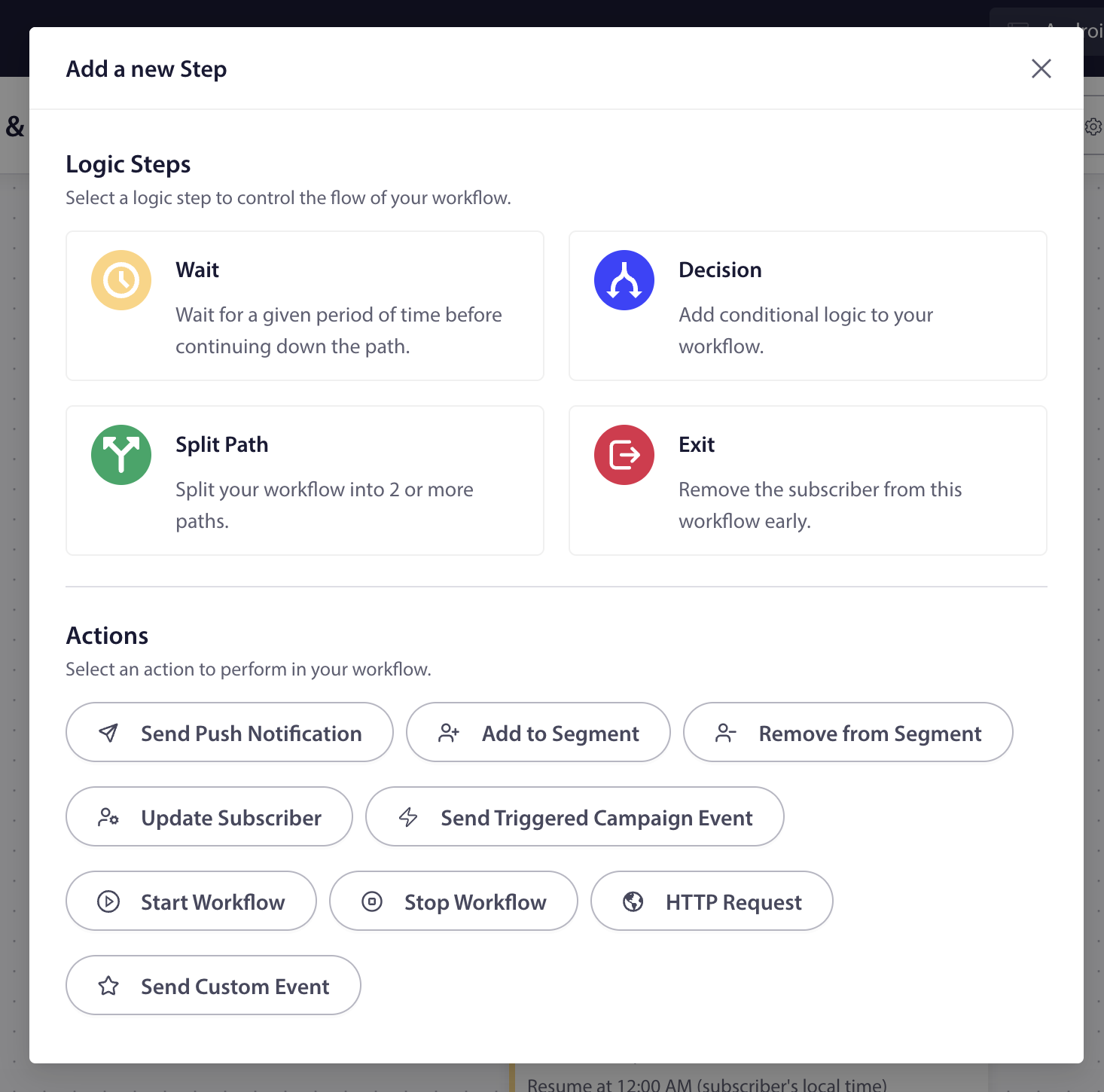
A drag-and-drop canvas for welcome series, cart recovery, and win-backs. Wait, branch on behavior, then send or move the subscriber to a segment. Higher plans add split paths, starting another workflow, and HTTP requests.
- The builder is on every plan: Free runs 1 active workflow of up to 5 steps
- Business: 5 active workflows, 10 steps each, with wait and decision nodes
- Split Path and Workflow Chaining on Premium and above; HTTP request actions on Growth
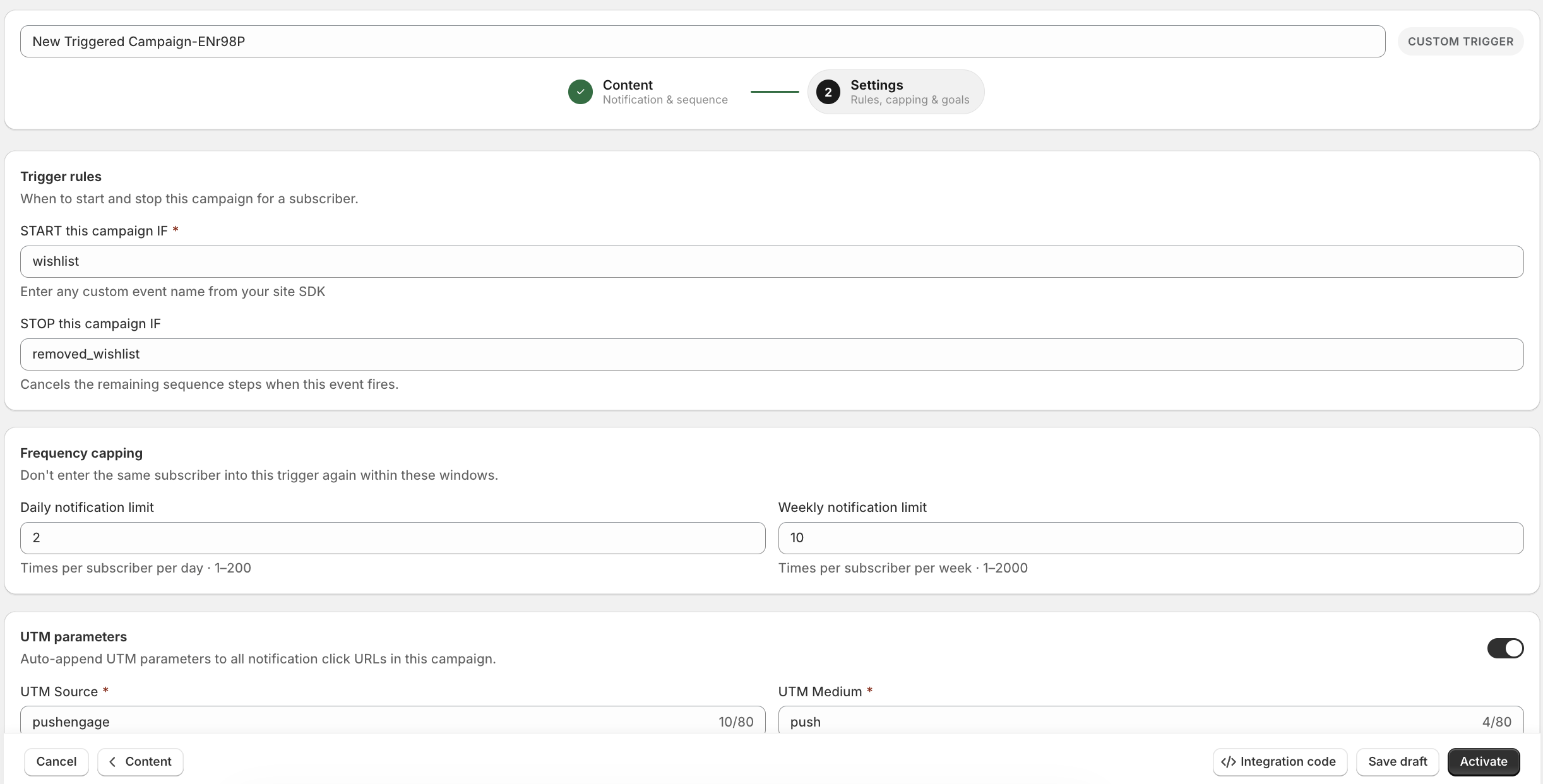
Trigger rules your team sets without a ticket
On Growth and above, start a campaign on any event your site or app fires, stop it on another, and cap how often one subscriber hears from you.
- Custom start and stop events from the SDK or REST API
- Daily and weekly frequency capping on triggered campaigns
- UTM parameters added to every click URL
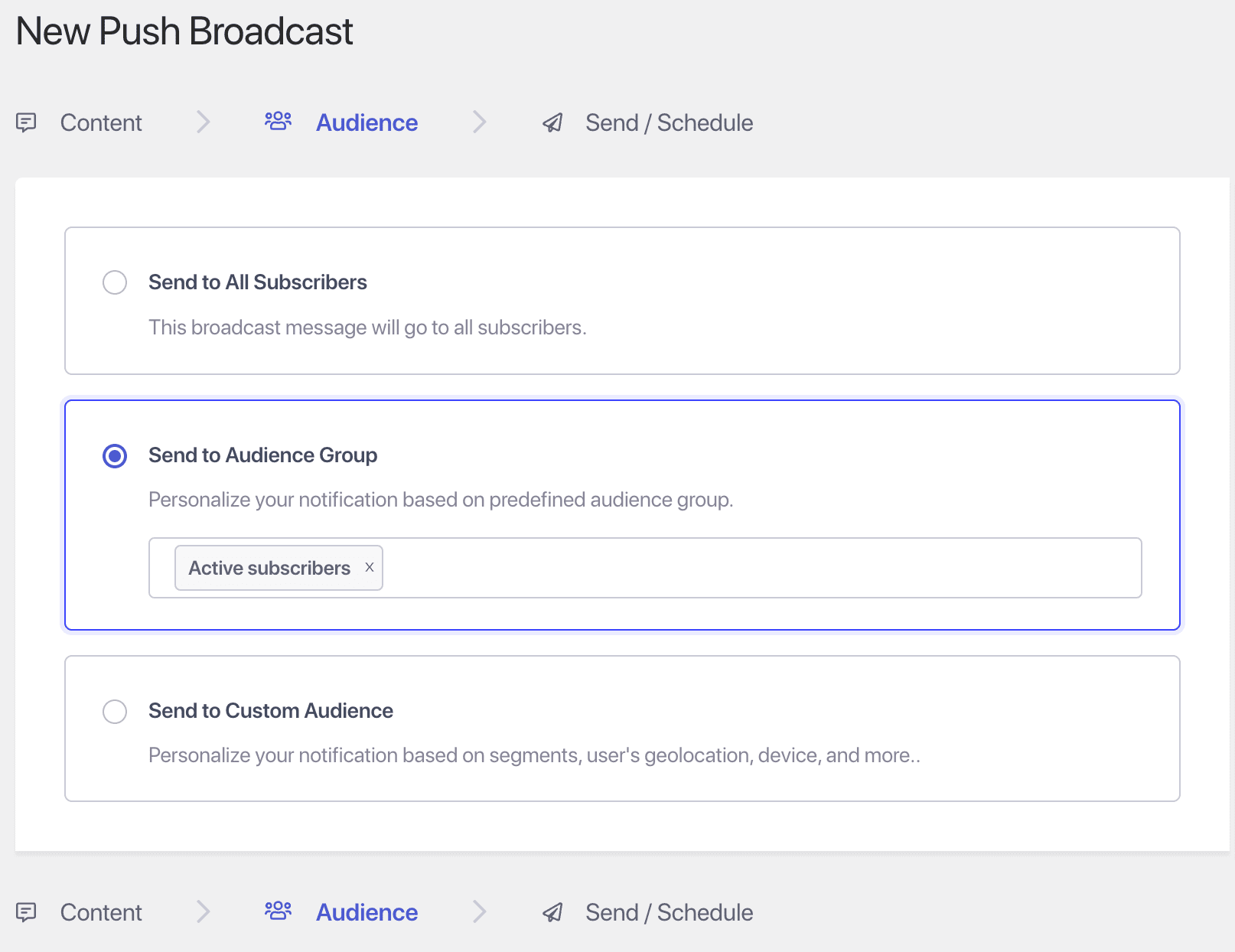
Segments built on active subscribers
Send to everyone, to a saved audience group such as active subscribers, or to a segment by URL, geography, device, or purchase behavior. Groups update themselves.
- Dynamic segments and audience groups without a developer
- Attributes set from the SDK or API for one-to-one copy
- Inactive Subscriber Cleanup keeps the count and the bill honest

A/B tests that pick their own winner
Test two headlines, images, or calls to action on a sample. After the delay you set, the better click rate goes to everyone else.
- Sample size and delay under your control
- Winner chosen on click-through rate
- On Premium and above

Opt-in prompts that earn the Allow click
When the prompt fires matters more than what it says. Trigger it by time on page, scroll depth, or a click, match it to your site, and segment subscribers as they join.
- Popup templates with desktop and mobile previews
- Triggers by time on page, scroll depth, or button click
- Segment on subscribe so the first campaign is already targeted
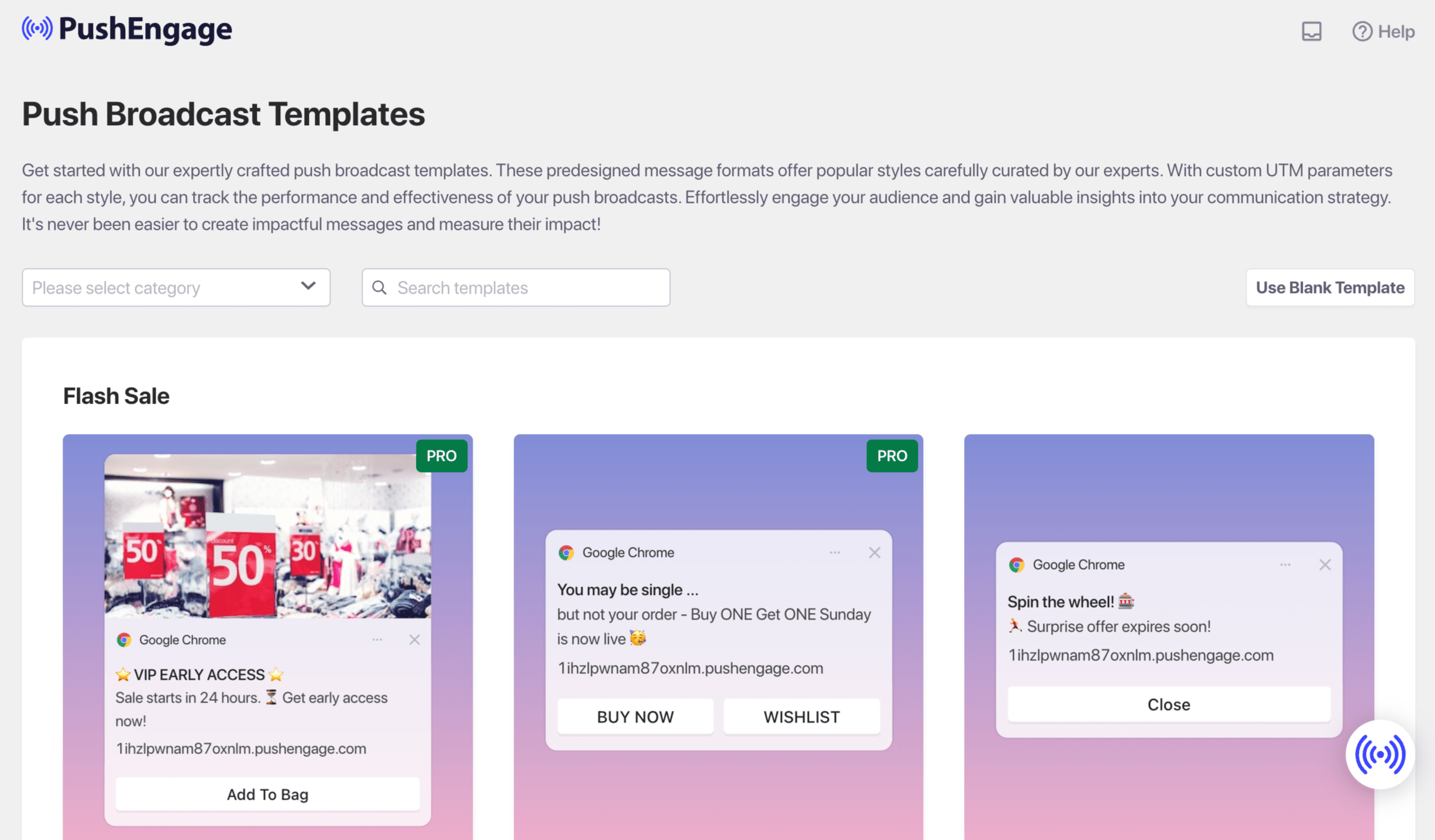
Start from a template, not a blank field
Broadcast templates by category, each tagged with its own UTM so you can see which style earns the click. Pick one, swap the copy, send.
- Templates for sales, launches, content, and win-backs
- UTM tracking per template for clean attribution
- Blank template when you want full control
Also in the product
The tools you would otherwise brief an engineer to build.
Templates, timing, alerts, compliance, and agent access come with the product.
Goal tracking and revenue analytics
Tie orders and signups to the notification that drove them, per campaign and per workflow. Premium and above.
See goal trackingTimezone delivery
Every subscriber gets the campaign at their own 9 AM, not yours. Premium and above.
See timezone deliveryBrowse abandonment
Catch the shopper who looked but never added to cart, while the intent is warm.
See browse abandonmentPrice drop alerts
Shoppers subscribe to a product and the alert fires itself when the price falls.
See price drop alertsBack in stock alerts
Turn a sold-out page into a waitlist that converts the moment stock returns.
See back in stockPersonalization and attributes
Merge tags for name, product, price, and any attribute you store on a subscriber.
See personalizationGDPR and CCPA tooling
Consent controls and data handling designed into the product, not bolted on.
See complianceChrome and Firefox extension
Draft, schedule, and send a push from any browser tab, with UTM fields filled in.
See the extensionMCP server and Agent Skills
Let Claude or Cursor build segments, run campaigns, and pull analytics, on top of the REST API.
See the developer hubChannels
Web push, app push, in-app, WhatsApp, and chat. One subscriber profile.
Pushwoosh covers more channels, email and SMS included. PushEngage covers the channels a retention team uses to bring a shopper back in seconds, in the same dashboard and reports.
Web push notifications
Browser notifications on Chrome, Firefox, Edge, and Safari, including home-screen web apps on iOS 16.4+, with plugins for WordPress, WooCommerce, and Shopify.
See web push notificationsMobile app push notifications
Native SDKs for iOS, Android, Flutter, and React Native, on the same subscriber profile and reports as web push.
See mobile app push notificationsIn-app messaging
Top banner, bottom banner, center modal, or full screen, triggered on real events. On every plan, with usage limits by plan; live in the Android SDK first, with more SDKs to follow.
See in-app messagingWhatsApp automation
Order updates on every paid plan and cart recovery on Growth and above, through your own Meta Business account. Runs on Shopify and on WordPress with WooCommerce.
See WhatsApp automationChat widget
Routes visitors to WhatsApp, Messenger, Telegram, email, or SMS: 21 channels plus custom links, with no hosted inbox to staff.
See the chat widgetPWA push notifications
Push for progressive web apps installed to the home screen, including home-screen web apps on iOS 16.4+.
See PWA push notificationsSetting up push for a progressive web app? Read the PWA push notifications guide.
Switching or adding
Run it next to Pushwoosh first, then decide.
You do not have to rip anything out to find out. Move your subscribers the documented way, rebuild one journey in Workflows, and compare on real traffic.
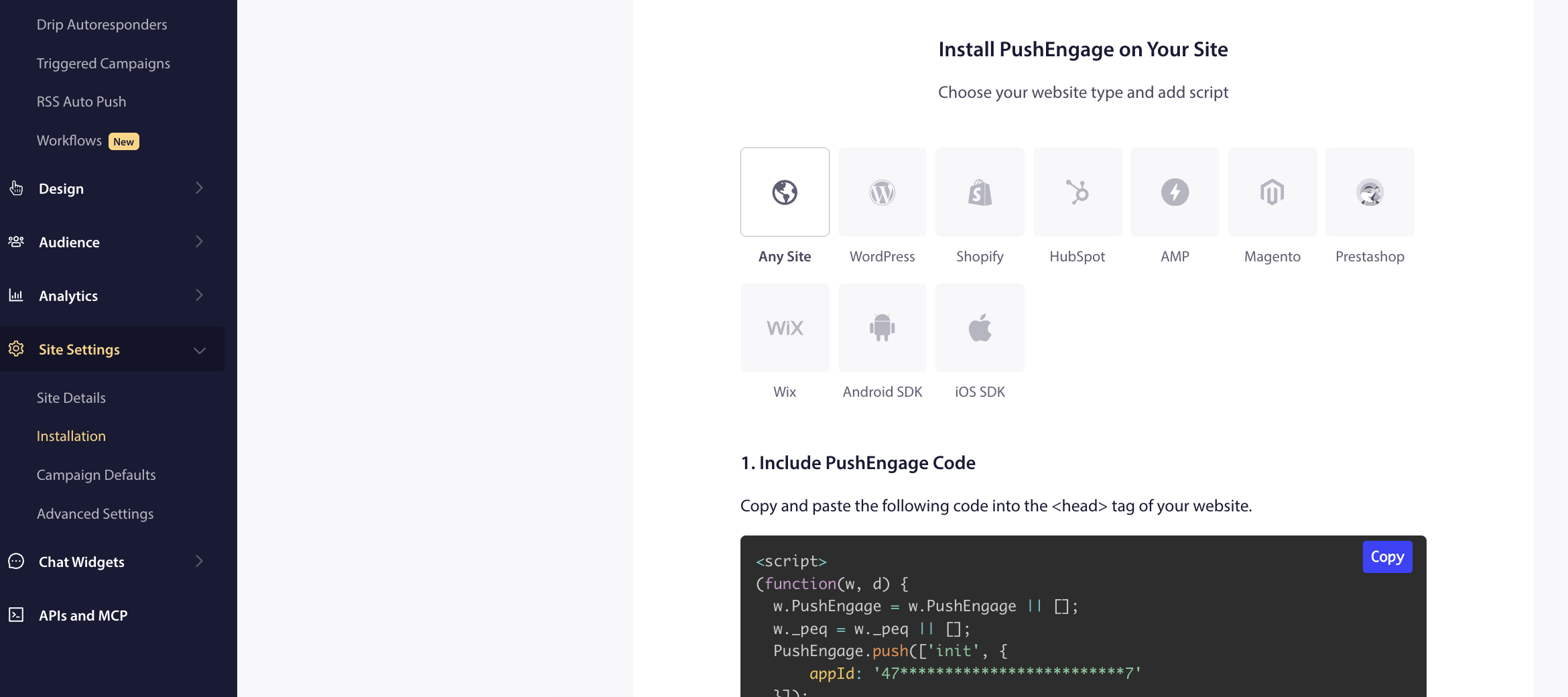
One installer for every platform you run
Pick your platform, paste one snippet or install the plugin, and you are live. Mobile follows the same path with the native SDKs.
- WordPress, Shopify, HubSpot, AMP, PrestaShop, Wix, or any site
- iOS, Android, Flutter, and React Native SDKs for app push
- Service worker and install code generated in the dashboard
Talk to our team first
Book a demo and bring the Pushwoosh journey you want to move. We map it to Workflows and check what your current setup allows before you change anything.
- Free plan to test on your own site
- Map segments, tags, and events you need
- Enterprise gets a technical onboarding contact
Move web and app subscribers
Web push: if Pushwoosh can export each subscriber’s endpoint, auth key, p256dh, and VAPID keys, we import the list. If not, silent resubscribe brings people over on their next visit with no second opt-in, so reachability starts lower and climbs as they return. App push: reuse your App Push ID, p12 certificate, and Firebase Sender ID, and plan the cutover around your app versions.
- WordPress, WooCommerce, Shopify, and Shopify Plus plugins
- iOS, Android, Flutter, and React Native SDKs
- REST API and Zapier for your engineers, webhooks on Growth
Rebuild the journey, then compare
Recreate the journey in Workflows, run both for a few weeks, and compare clicks and attributed revenue before you decide what moves. Paid plans carry a 14-day money-back guarantee.
- Goal tracking on Premium and above
- Split Path tests on Premium and above
- Quiet hours inside every workflow
The short version
A/B push journeys at a subscriber price.
Pushwoosh meters monthly active users across a long list of channels. PushEngage meters the subscribers who opted in to push, with Workflows, Split Path, and the setup in a plugin.
Keep comparing
Other comparisons, same honest format.
PushEngage vs OneSignal
Two usage meters against one fixed tier, with a calculator and worked examples.
Compare with OneSignalPushEngage vs Braze
An enterprise customer engagement suite against push, in-app, and chat your marketing team runs itself.
Compare with BrazePushEngage vs MoEngage
An agentic customer engagement platform on a quoted contract against published push pricing.
Compare with MoEngagePushEngage vs CleverTap
MAU-priced engagement and analytics against subscriber-priced push, in-app, and chat.
Compare with CleverTapPushEngage vs WebEngage
A customer data and marketing suite on an order form against push your team runs at published prices.
Compare with WebEngagePushEngage vs Batch
Batch.com’s EU-hosted CRM engagement platform on a quoted contract against web and app push at published prices.
Compare with BatchPushEngage vs Airship
Enterprise mobile app engagement against web and app push on one published plan.
Compare with AirshipPushEngage vs iZooto
Web push for publishers, with ads in push, against retention push for stores and publishers.
Compare with iZootoPushEngage vs Klaviyo
Email and SMS first for eCommerce, and where browser and app push fit next to it.
Compare with KlaviyoPushEngage vs Omnisend
Email and SMS first for online stores, and where app push, in-app, and Safari push fit next to it.
Compare with OmnisendPushEngage vs PushOwl
A Shopify web push app against push for Shopify, WooCommerce, any site, and your app.
Compare with PushOwlPushEngage vs Firebase Cloud Messaging
Free delivery infrastructure against the marketing layer that runs on top of it.
Compare with FCMPushEngage Workflows
Wait, Decision, Split Path, and Exit steps on one canvas, with the builder on every plan.
Explore WorkflowsPush notification service
The push notification service built for eCommerce retention teams.
See the servicePush notification software
A buyer’s checklist for evaluating push notification software.
Read the checklistFAQ
Questions, answered.
Is PushEngage a Pushwoosh alternative?
For web push, app push, in-app, WhatsApp, and chat, PushEngage covers the job for many mid-market retention teams, and your marketing team can run web push without a developer. It is not a replacement for all of Pushwoosh: PushEngage does not send email or SMS, and Pushwoosh’s journey builder has more step types and automatic A/B winners. If you need email, SMS, and push in one journey, Pushwoosh is the better fit.
Can PushEngage run automated multi-step push workflows with A/B split paths?
Yes. PushEngage Workflows put Wait, Decision, Split Path, and Exit steps on one canvas. A typical store journey: a shopper joins a segment, waits a day until 10 AM in their timezone, a Decision step checks whether they clicked a notification in the last 7 days, a Split Path sends half one offer and half another, and each path sends a push. Wait and Decision start on Business, Split Path and Workflow Chaining on Premium and above, and HTTP request actions on Growth. Workflow sends go to web push and app push.
How much does Pushwoosh cost?
Pushwoosh publishes prices per 1,000 monthly active users: $13 on its all-channel plan, “Omnichannel”, and $7 on Push only, a limited offer for sign-ups by December 31, 2026 that is locked for 24 months. The first 1,000 MAU are free, and above $3,000 a month there is a custom plan. At 50,000 MAU its calculator gives $343 a month on Push only and $637 on “Omnichannel”. Prices are from pushwoosh.com/pricing on October 5, 2026.
How is a Pushwoosh MAU different from a PushEngage subscriber?
Pushwoosh’s metrics glossary defines a monthly active user as a unique user who opened the app in a calendar month, and its pricing FAQ says anyone who receives a message on any channel also counts. On Push only, an MAU is a unique person you messaged by push, in-app, or web push that month. PushEngage counts active subscribers: people who opted in to push and can still receive it, priced on a fixed tier whether or not you message them that month.
Does PushEngage have send-time optimization?
Partly. On Premium and above, PushEngage sends in each subscriber’s own timezone: schedule 9 AM and every subscriber gets it at 9 AM local time, and you can A/B test send times. It does not predict a best send time for each subscriber. Pushwoosh’s Best time to send does that for push, picking a time per user within 24 hours. If per-user timing is a must, weigh that in your evaluation.
Which is faster to set up for web push?
On PushEngage, install the WordPress, WooCommerce, or Shopify plugin, or on any other site add our JavaScript and a service worker file at your site root once, then design the opt-in prompt in the dashboard. Pushwoosh’s web push guide has you host pushwoosh-service-worker.js at your site root and add its init script, or use Google Tag Manager, and its Shopify app collects opt-ins through a theme embed. Its pricing FAQ puts SDK integration, user import, and first subscribers at 2 to 10 days.
Can we run PushEngage alongside Pushwoosh?
Yes. Keep Pushwoosh for email, SMS, or a mobile app journey and run web push and Workflows from PushEngage, or the reverse split. Set frequency limits in both tools so one shopper does not hear from you twice for the same cart. In PushEngage, quiet hours apply inside each workflow, and daily and weekly caps apply to triggered campaigns on Growth and above.
Can we move our Pushwoosh subscribers to PushEngage?
There are two paths for web push. If Pushwoosh can export each subscriber’s endpoint, auth key, p256dh, and VAPID keys, PushEngage imports the list directly. If it cannot, silent resubscribe brings people over on their next visit with no second opt-in, so reachability starts lower and climbs as they return. For app push, you reuse your App Push ID, p12 certificate, and Firebase Sender ID, and plan the cutover around your app versions. Book a demo and we will plan it with you.
Does PushEngage work with Shopify and WooCommerce?
Yes. PushEngage has a Shopify and Shopify Plus app and a WordPress and WooCommerce plugin. Cart abandonment, browse abandonment, price drop, and back-in-stock campaigns are ready to switch on from the Growth plan. Pushwoosh offers a Shopify app that syncs orders, carts, and browsing events, plus a Magento 2 integration.
What does Pushwoosh do that PushEngage does not?
Email, SMS, Kakao, LINE, Telegram, Viber, and wallet passes, web popups for offers, A/B/n splits with an automatic winner, waits that branch on events, holdout groups, a per-user best time to send, journey retention statistics, and SDKs for Unity, Cordova, Capacitor, Windows, and macOS. If those are on your list, evaluate Pushwoosh. If your list is web push, app push, A/B push journeys, in-app, WhatsApp, and chat, PushEngage is built for that job.
Run your A/B push journey this week.
See every tier on the pricing page, or book a demo and we will map your Pushwoosh journeys to PushEngage Workflows. If it is not the best fit within 14 days, we refund 100%. No questions asked.
Prices published for every self-serve tier 14-day money-back guarantee One subscriber profile for web and app