
Is bounce rate a ranking factor? SEO can be fairly complicated because there’s a ton of guesswork around how Google’s algorithm actually works.
You can simply install a WordPress SEO plugin and follow along with their guidelines. But how effective are those checklists? And what about metrics like bounce rate that an SEO tool can’t directly optimize for you? Exactly how important is bounce rate?
Luckily, we have friends everywhere and our friends at AIOSEO spoke to us about bounce rates and what they actually mean. We even went into detail about their findings from their user base of 3 million+ SEO professionals.
So, is bounce rate a ranking factor? The short answer is no.
In this article, we explain how bounce rate is defined in GA4, and provide practical analysis tips.
Commençons.
PushEngage est le plugin de notifications push n°1 au monde. Obtenez-le gratuitement !
Why is Bounce Rate?
Let’s talk about what bounce rate is and how Google Analytics 4 (GA4) defines it. Bounce rate used to be defined as the percentage of website visitors who leave without clicking through to any other page on your site.
So, a bounce is essentially the opposite of user engagement. In some contexts, this is REALLY bad. But in certain cases, a bounce could very well be the measure of success. For example, if you run ad campaigns sending traffic to a single-page website, the page would have a 100% bounce rate no matter how many sales you get.
And this lack of clarity prompted Google to update their definition. Bounce rate in GA4 is defined as the percentage of website visitors
- Visit a single page in a single session for less than 10 seconds
- And have no interactions
Bounce rate didn’t originally account for time spent on the page or any goal-based events on your site. Events are milestones that lead to a specific business goal. Website events are measurable user actions. Google Analytics can be set up to track events such as scrolling down a page, filling out a form, watching a video, downloading a PDF, or buying something.
And with this new definition, bounce rate seems to be a much clearer metric of your page’s performance. So, is bounce rate a ranking factor now? Again, not really.
Is Bounce Rate a Ranking Factor?
Ever wondered what really goes on behind the scenes of Google Search? It’s like a digital treasure hunt, and experts love to play detective, trying to crack the code of those super-secret algorithms.
But here’s the thing: Not every theory pans out. Sometimes, folks get a bit carried away, confusing cause and effect. Let’s take a dive into the buzz around bounce rate, for example.
This is a fairly common theme with a lot of different statistical studies. Just because Event A and Event B seem to occur together a fair number of times doesn’t mean that Event A always leads to Event B.
Some big shots in the SEO world suggested that bounce rate might have a say in how Google ranks stuff. Well, the idea caught fire, and suddenly, blogs everywhere were shouting from the rooftops that bounce rate was the holy grail of rankings. That set off a chain reaction, bringing in concepts like dwell time and pogo-sticking as the new ranking heroes.
Just to break it down, dwell time is how long you hang out on a page after clicking from the search results. And pogo-sticking? That’s when you click on a result, think “Nah, not my jam,” and boing right back to the search results page.
The plot thickened, dragging 404 errors into the mix. Some started believing these error pages were messing with rankings, all thanks to a supposed link to bounce rate and pogo-sticking.
But you should really take it all with a pinch of skepticism. Google’s algorithms are still the ultimate mystery, and sometimes, a little caution is the best strategy when navigating the SEO jungle. So, the next time you hear someone swear by bounce rate as the magic potion for rankings, just remember, the Google algorithm plot twist is still unfolding.
Stay curious, but keep that detective hat on!
Why Bounce Rate is Not a Ranking Factor
Here’s the lowdown on why those speculations don’t quite add up – they’re running on empty when it comes to evidence.
Let’s set the record straight: Google bigwigs have been vocal about bounce rate not being the golden ticket to search rankings.
In a candid 2020 Q&A session, Google Senior Search Analyst John Mueller was asked, “Is bounce rate a ranking factor?” and he threw it out there that it’s all a “misconception.” According to him, bounce rate, and any other Google Analytics data, doesn’t make the cut for Google’s ranking algorithms. Case closed – that’s a firm “definitely not the case” from Mueller.
And it’s not a one-time thing. Google Analyst Gary Illyes chimed in too, making it crystal clear that “we don’t use analytics/bounce rate in search ranking.”
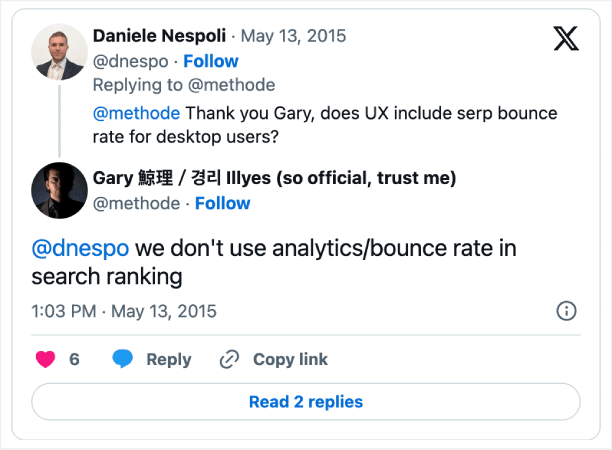
So, is bounce rate a ranking factor? Google’s top brass says no!
How to Improve SEO and Boost Engagement
While it’s been pretty much confirmed multiple times that bounce rate is not a ranking factor in Google Search, it’s still a useful metric. The content you create must serve a purpose. And when that purpose is marketed to the right people the right way, you can expect low bounce rates.
If you’re new to WordPress SEO, we recommend using an SEO rank tracker WordPress plugin to keep tabs on how your content in performing.
Step #1: Install an SEO Rank Tracker WordPress Plugin
Before you can track SEO keyword rankings for your WordPress site, you need to pick the right WordPress SEO plugin. We recommend using All In One SEO.
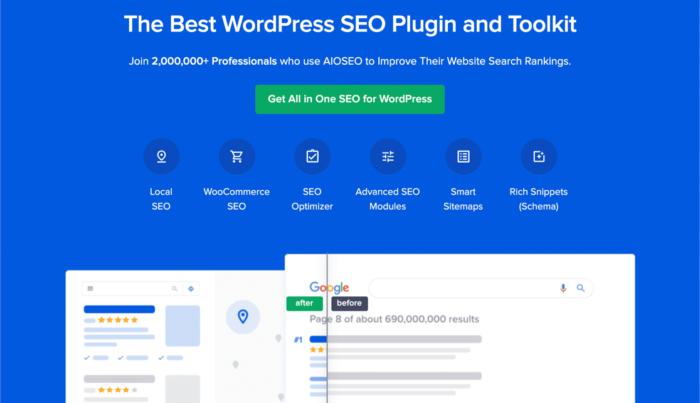
All in One SEO (AIOSEO) est l'un des plugins SEO les plus acclamés dans la communauté WordPress. La version originale a été entièrement remaniée pour ajouter une tonne de nouvelles fonctionnalités et d'extensions. Donc, si vous avez utilisé AIOSEO dans le passé, vous devez revoir le plugin une fois de plus.
Non seulement AIOSEO dispose de fonctionnalités SEO suffisamment puissantes pour mettre en œuvre les dernières meilleures pratiques SEO, mais vous bénéficiez également de paramètres SEO avancés pour résoudre des problèmes SEO spécifiques dès le départ. Cela inclut :
- Modules SEO locaux pour les petites entreprises ayant une audience locale
- SEO WooCommerce pour les boutiques en ligne
- Un optimiseur SEO à l'intérieur de votre éditeur WordPress
- Smart Sitemaps pour un indexation instantanée sur les moteurs de recherche
- Un plugin Schema pour que votre contenu se classe dans les Rich Snippets
And of course, you also get a built-in SEO rank tracker to stay on top of your SEO rankings.
En bref : All in One SEO vous permet de configurer correctement le SEO WordPress sans jamais avoir à engager un expert. Et si les plus de 3 millions de clients d'All in One SEO sont à croire (nous y compris), AIOSEO est un logiciel d'optimisation pour les moteurs de recherche fantastique pour toutes les exigences SEO.
C'est parfait pour les blogueurs et les propriétaires de petites entreprises car cela vous aide à prendre en charge le SEO sans avoir à engager un professionnel. Vous pouvez nous croire dans notre avis sur All in One SEO, ou vous pouvez lire l'impact qu'AIOSEO a pour aider les entreprises à être tendance dans les résultats de recherche.
Rappel : Vous ne pouvez intégrer Google Search Console qu'avec All in One SEO. Si vous avez besoin d'analyses de site Web plus détaillées, vous devriez envisager d'installer le plugin MonsterInsights pour installer Google Analytics sur votre site WordPress.
Step #2: Get an Overview of Keyword Rankings
Head over to the Search Statistics section in the WordPress plugin to see an overview of your keyword rankings:
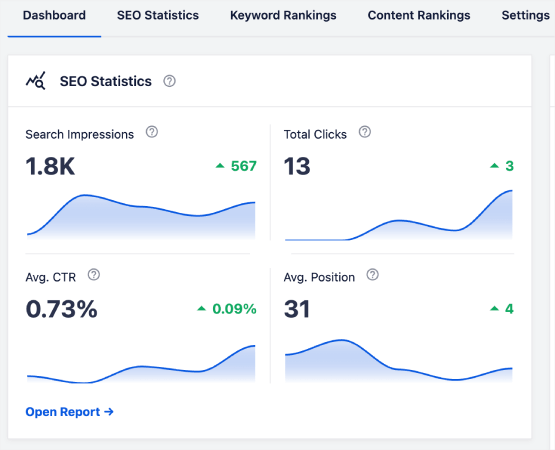
Le tableau de bord principal dispose également d'une section Classements des mots-clés qui montre un aperçu de vos Mots-clés principaux et de vos mots-clés Gagnants/Perdants.
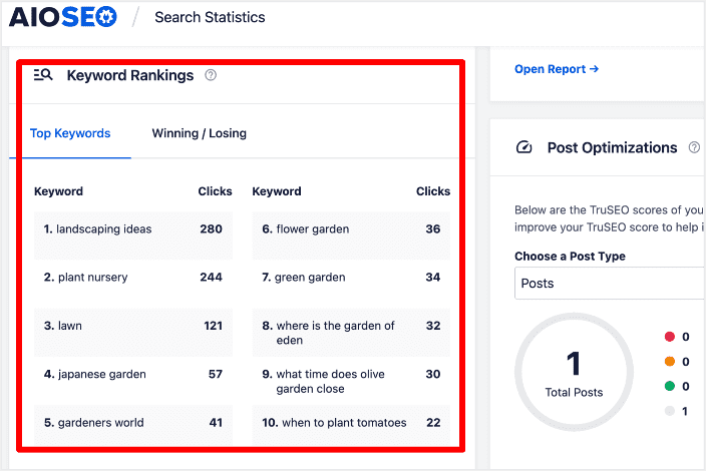
Comprendre quels mots-clés perdent du terrain dans les classements, c'est comme découvrir où il manque des pièces à votre puzzle. Cela vous aide à comprendre ce qui se passe avec ces pages et à planifier une stratégie pour retrouver ces positions.
And guess what? When you do that, you’ll see more people visiting your site, which means more money in your pocket. It’s like solving a puzzle to make your website even better!
On the other hand, the Top Winning keywords can give you insight into the SEO tactics that are producing results so you can replicate them.
Step #3: Dive Deep into the Keyword Rankings Report
Une fois que vous avez une idée générale de la performance de vos mots-clés, l'étape suivante consiste à ouvrir le rapport Classements des mots-clés. Vous pouvez également y voir des statistiques détaillées sur les classements de votre contenu.
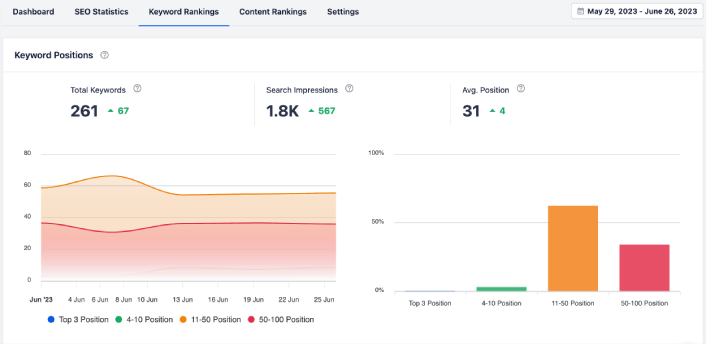
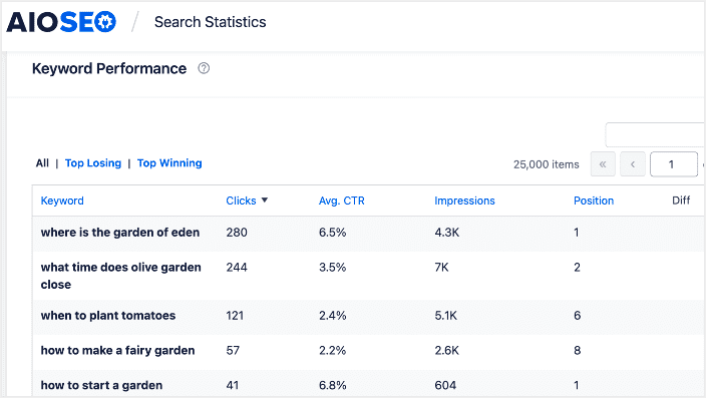
Si vous faites défiler plus loin, vous pouvez même voir les articles exacts qui gagnent ou perdent des classements de recherche. De plus, vous pouvez filtrer vos meilleurs mots-clés par clics et vérifier leurs classements instantanément.
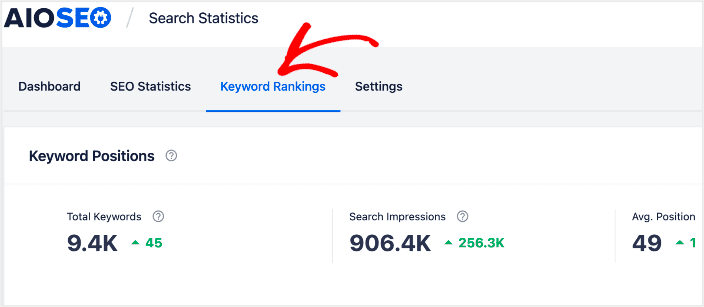
C'est ici que vous obtenez un rapport détaillé de tous vos mots-clés et de leurs performances sur les SERP. Faire défiler vers la section Performance des mots-clés vous donne un aperçu plus approfondi des performances de chaque mot-clé individuel.
C'est l'endroit où vous obtenez un rapport complet sur tous les mots que vous utilisez et sur la façon dont ils se comportent dans les résultats de recherche. Lorsque vous faites défiler vers la partie Performance des mots-clés, vous plongez plus profondément dans la façon dont chaque mot se porte tout seul.
Si vous cliquez sur l'onglet Top Gagnants, vous verrez les mots-clés qui s'améliorent dans les classements.
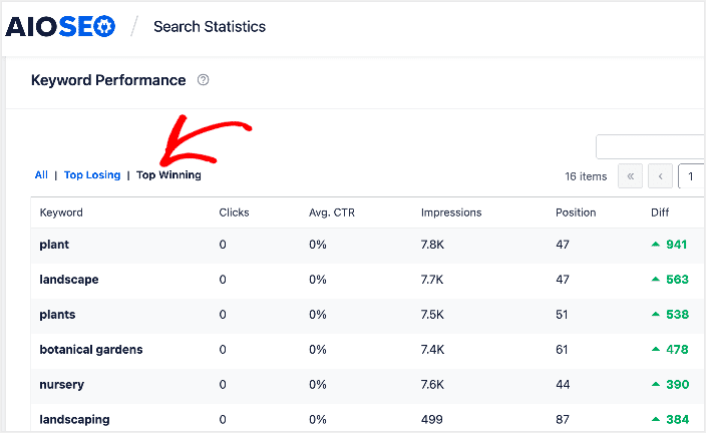
These show that you’ve optimized well for the target keywords and that your SEO strategy is working.
Step #4: Check Your Top Losing Keywords
En plus de vérifier vos mots-clés Top Gagnants, vous pouvez également suivre vos mots-clés Top Perdants. Cliquez sur l'onglet Top Perdants dans le rapport Performance des mots-clés pour ce faire.
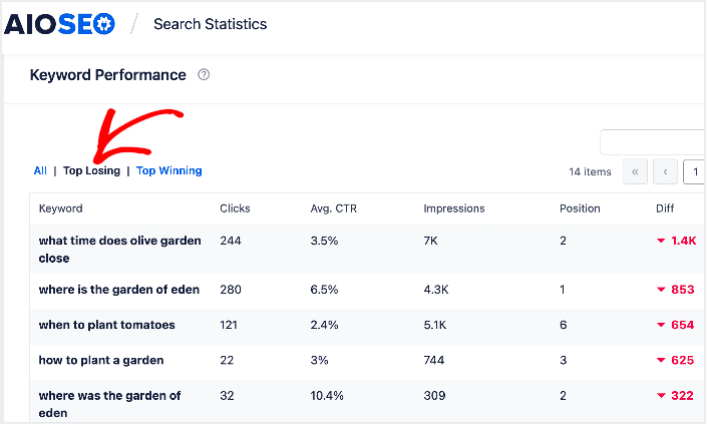
Cette section montre les mots-clés qui chutent dans les classements. C’est une information vitale car elle vous montre les mots-clés et le contenu à optimiser. Si vos classements de mots-clés chutent, vous devez mettre à jour votre contenu immédiatement.
What to do After You Track SEO Traffic and Rankings?
Tracking your search traffic and rankings is only one part of the puzzle. Our top recommendation is to use All in One SEO to optimize your website content. The right tools can help you with getting repeat traffic, engagement, and sales. For that, we recommend using push campaigns.
Les notifications push peuvent être un outil marketing puissant pour les entreprises en croissance. Pas convaincu ? Consultez ces ressources exceptionnelles :
- 7 stratégies intelligentes pour stimuler l'engagement client
- Les notifications push sont-elles efficaces ? 7 statistiques + 3 conseils d'experts
- Comment ajouter un plugin WordPress de notifications Web à votre site
- Comment configurer des notifications push pour paniers abandonnés (Tutoriel facile)
Nous vous recommandons d'utiliser PushEngage pour créer vos campagnes de notifications push. PushEngage est le logiciel de notifications push n° 1 au monde. Donc, si ce n'est pas déjà fait, commencez dès aujourd'hui avec PushEngage !


