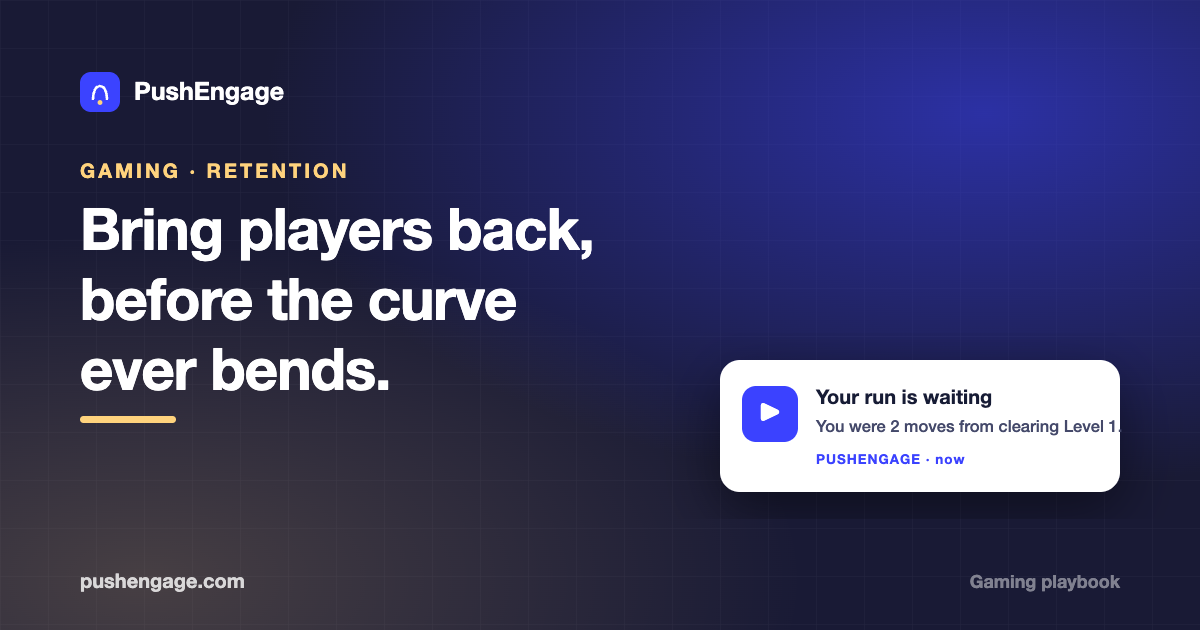
用于游戏留存的推送通知 — PushEngage 游戏手册封面图

用于游戏留存的推送通知:提升曲线的工作流

Your Monday retention review opens on the same chart it always does. Day 1 retention is holding around 27%. Day 7 has slid to 8%. By Day 30, fewer than two players in a hundred are still opening the app. The push notifications you sent last week pulled a respectable open rate, and yet the curve did not move. That gap, between a notification that gets tapped and a player who actually comes back and keeps playing, is the entire problem with how most studios use push notifications for game retention.

The numbers above are not unusual. GameAnalytics’ 2025 mobile gaming benchmarks put median Day 7 retention between 3.4% and 3.9%, with even top-quartile titles landing around 7–8%, and median Day 30 retention under 1%. Push is one of the few owned channels that can intervene before a player slides down that curve. But it only works when it is built as a set of triggered workflows tied to in-game behavior and revenue, not as a calendar of blasts measured in opens.

This article lays out that approach: why opens are the wrong scoreboard, the four lifecycle moments that decide whether a player returns, four push notification workflows you can build against them, the app-push-plus-web-push lane your competitors ignore, and how to attribute every notification to in-game revenue rather than taps.

Why most game push notifications get opened and ignored

An open is not a return. A return is not a session. A session is not progression. And progression is what actually predicts whether a player is still around on Day 30. When a notification earns a tap but the player bounces off the home screen, or plays for forty seconds and leaves, the retention curve does not care that your open rate was 22%.

This is the measurement trap nearly every guide on game push notifications falls into. They optimize the headline, the emoji, and the send time to lift opens, then report the open rate as the win. Opens are a leading indicator at best and a vanity metric at worst. The behavior you need is a returning player who reaches the next meaningful milestone.

Push can cue that behavior. It cannot fake it. A notification can put a player back in front of a reason to play: an unclaimed reward, a friend’s turn, a refilled energy bar, a limited event ending soon. What happens next is decided by your game loop. So the job of push notifications for game retention is narrow and specific: deliver the right reason to return, to the right player, at the moment that reason is real, and then measure whether they progressed, not whether they tapped.

Retention is a lifecycle, not a blast: the four moments that decide whether a player comes back

The player retention strategies that actually work fire on behavior, not the calendar. “Tuesday 6pm to everyone” is a blast. “Fires the moment a player installs but has not finished the tutorial after 20 minutes” is a trigger. Triggers map to lifecycle moments, and four moments do most of the work.

The player retention strategies that map to each moment

Lifecycle momentThe behavioral signalWhat’s at risk
First sessionInstalled, but first milestone not reachedThe steepest churn cliff in the entire curve; most players who quit, quit here
Onboarding to habitPlayed a few times, no routine formed yetThe player never becomes a regular; Day 7 collapses
Habit to loyalPlays regularly, hits a streak or progression wallA frustrated or bored regular drifts to dormant
Slipping to dormantDays since last session crossing a thresholdThe player is gone unless reactivated; full re-acquisition cost looms

Each moment is a trigger waiting to be built. The first session moment is the one the rest of the SERP treats as a footnote, even though it is where most of the curve is lost. A player who does not reach a first win in the opening minutes rarely comes back on their own. That is a real-time trigger, not a next-day email.

Four push notification workflows for game retention (triggers, timing, exit criteria)

Here are four workflows that cover the lifecycle above. Each is defined the way a retention operator should define it: a trigger that starts it, timing between touches, the message’s job, and the part almost every competing article omits, an exit criterion so the player stops hearing from a workflow once it has done its job. You can build the workflow visually without an engineering ticket, which matters when the people who own retention are not the people who own the build.

工作流触发器时机Message jobExit criterion
First-session saveInstall with no first milestone+20 min, +24 hrPull the player back to the first win they almost reachedFirst milestone reached
Habit builder / streak keeper2+ sessions, no daily routineDaily at the player’s usual play hour, max 1/dayProtect a streak, surface today’s reason to openHabit formed (e.g. 5 sessions in 7 days) or player goes dormant → hands to win-back
Progression & reward re-entryUnclaimed reward, refilled energy, or new contentEvent-based, fire when the reason becomes true“Your reward is waiting” / “Your turn in the match”Reward claimed or content viewed
Slipping-player win-back7–14 days since last session+7 days, +14 days, then stopOffer a specific reason to return, not guiltPlayer returns, or workflow ends (no endless nagging)

A few notes a real build would respect. The first-session save is the highest-impact workflow you own, because it intervenes at the steepest part of the curve; its first touch should reference the exact thing the player was about to get, drawn from your own push notification onboarding templates. A first-session save is really a welcome notification with a deadline attached.

The streak keeper has to honor quiet hours and a frequency cap, or it becomes the reason a player mutes you. The win-back workflow exists to re-engage inactive players before they are gone for good. It is deliberately short here, two touches and a hard stop, because deep reactivation is its own discipline; if you want the full sequence design, see how to re-engage lapsed players.

Sample copy for the first-session save, second touch: “You were two moves from clearing Level 1. It’s still there when you are.” No exclamation mark, no false urgency, a concrete reference to where the player actually stopped.

App push and web push together: the channel the SERP forgot

What app push notifications for games can’t reach

Every competing article on this topic assumes one delivery surface: a mobile app firing game push notifications through FCM or APNs. Most coverage of app push notifications for games stops right there, at a single surface. That assumption leaves players unreachable. Games do not live only inside an installed app.

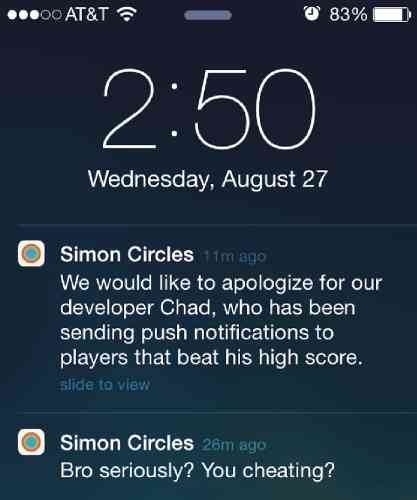
SimonCircles 创意推送通知

They live on companion sites where players check leaderboards, on HTML5 and browser builds, on community and patch-notes pages, and on desktop launchers. A player who never installs the app, or who uninstalled it but still visits your site, is invisible to an app-only stack.

This is where running web push notifications alongside app push notifications for games changes the math. Web push opt-in is not gated behind an app store install, so a visitor to your browser game or companion site can subscribe in one click, and you can reach them again whether or not they ever download the app. Consider a player who plays your HTML5 game on desktop at work and has never touched the mobile build. App push cannot reach them. Web push can, with the same “your turn” notification the app sends.

The point is not “use two tools.” It is one subscriber identity, one workflow, and one frequency cap spanning both surfaces, so a player who is active on the app does not also get pinged on the web for the same event. That orchestration across owned channels is the move no app-only competitor on the first page of results can make.

Tie every notification to in-game revenue, not opens

A retention owner eventually has to defend the channel to someone who controls budget. “Our reactivation push pulled a 19% open rate” does not survive that conversation. “Our first-session save workflow returned 4,100 players last month, of whom 1,300 reached the first purchase point, generating $11,400 in in-game purchase revenue” does.

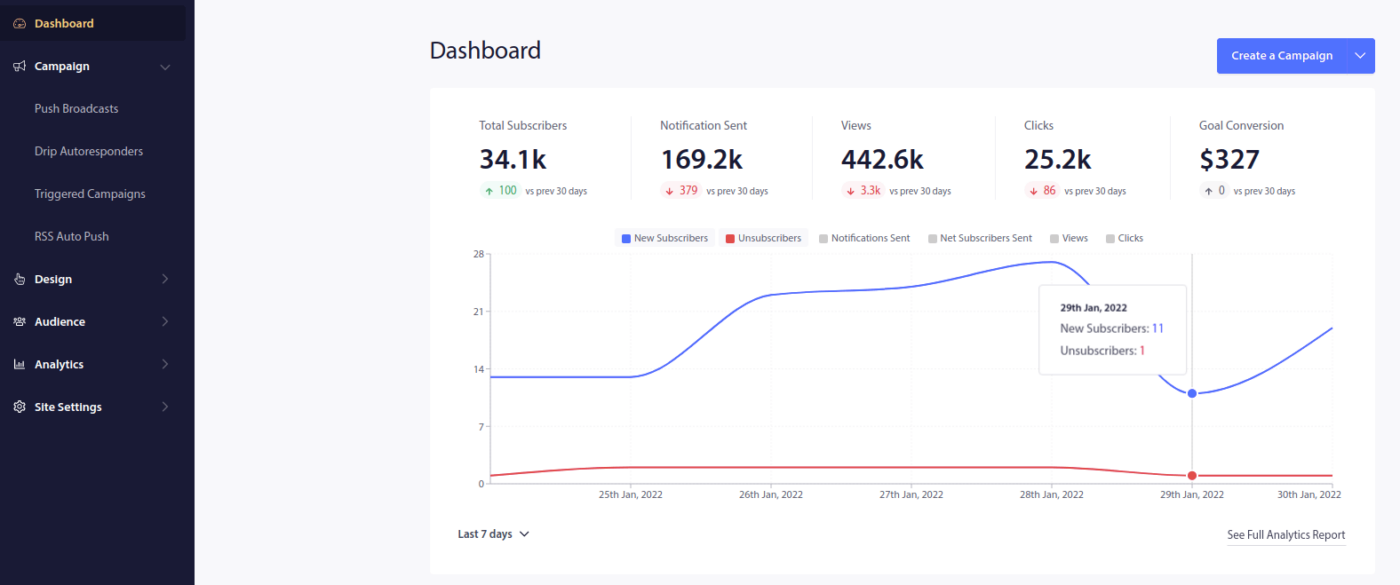
PushEngage 仪表板

The chain you need to instrument runs: notification delivered → session started → milestone or progression reached → in-game purchase or ad impression → 30-day LTV. Goal tracking at the notification level closes the loop, attributing revenue to the specific workflow and touch that produced it rather than to push as an undifferentiated blob.

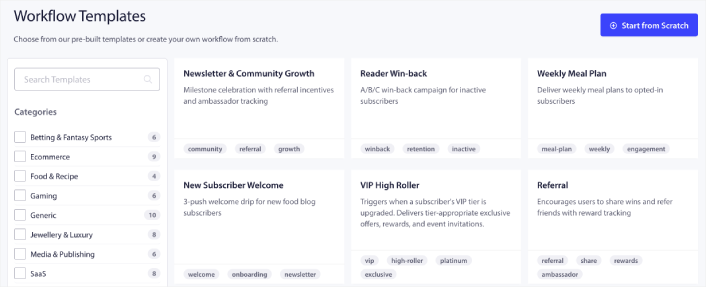
工作流模板

Once you can see revenue per workflow, you stop tuning for opens and start cutting the touches that move taps but not money, and doubling the ones that move LTV.

Making in-game purchase notifications a tracked revenue line

This is also how in-game purchase notifications earn their place. Track in-game purchase notifications as their own workflow with goal tracking attached, and the revenue per touch stops being a guess. A “your reward is waiting” message is not a retention nicety when you can show it returned players who then converted. It is a revenue line you can attribute, defend, and scale.

Segmentation is the retention work: progression, spend, and recency

Every guide says “segment your players.” Few say how, for a game. The retention version of RFM is built from three axes you already track: progression level, spend tier, and recency (days since last session). Cross them and the workflows above sharpen from broad to surgical.

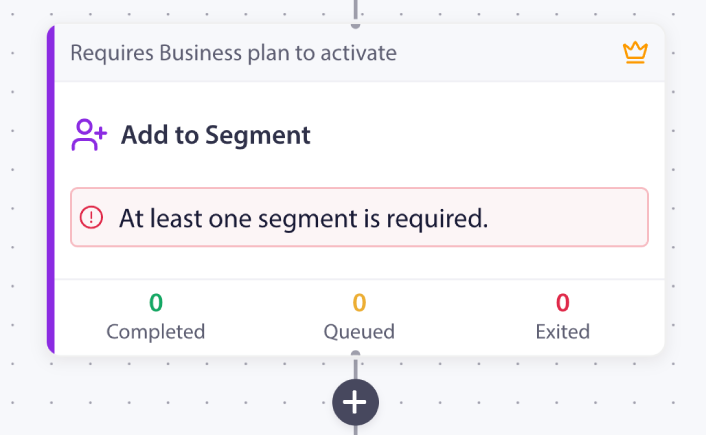
将细分添加到工作流

Three compound segments worth building first:

  • Slipping high-value player. Top spend tier, deep progression, 7+ days since last session. This is your most expensive player to lose and your cheapest to win back, so route them into a prioritized win-back with a genuinely valuable reason to return, not a generic nudge.
  • Tutorial quitter. Installed, never cleared the first milestone, low recency. The first-session save exists for exactly this segment; do not waste streak messaging on a player who never started.
  • Weekend-only casual. Mid progression, plays only Saturday and Sunday. Suppress weekday sends and concentrate the streak keeper on their actual play window.

Segmentation is what keeps these player retention strategies from becoming noise. The same workflow that retains a slipping whale will annoy a tutorial quitter. The segment decides who each trigger fires on, and getting that right is most of the difference between a channel players keep and a channel they mute.

What push can’t fix, and what it actually costs

Push amplifies a game loop worth returning to. It cannot manufacture one. If players churn because the core loop is thin, the difficulty spikes unfairly, or the monetization is hostile, no notification cadence will hold the curve, and sending more push to a game players have decided to leave only speeds the unsubscribes. The honest version of push notifications for game retention starts by accepting that push is a return path, not a reason to play.

Given that, the cost question matters. Acquiring a new player carries a full install cost: UA spend, store fees, the whole funnel. To re-engage inactive players costs a fraction of that, because the relationship and the channel already exist. The pricing model should match that logic.

PushEngage charges only for active subscribers, so when a player goes dormant and you stop reaching them, the bill shrinks rather than growing with a list you no longer message. Compare that to per-message billing or list-size pricing, and to the Firebase push notification pricing tradeoffs studios weigh when their volume of app push notifications for games scales.

That is the model PushEngage runs on: pay only for active subscribers.

That is the retention math in one line: the cheapest growth a game has is the player who already installed it. Build the four workflows, run them across app and web push, segment by progression and spend, and measure in revenue. That is how push notifications for game retention stops being a weekly blast and starts moving the curve you open every Monday.

Ready to build your first first-session save workflow? Start on the pay only for active subscribers plan and ship it this week.

添加评论

我们很高兴您选择留下评论。请记住,所有评论都将根据我们的隐私政策进行审核,并且所有链接都将是 nofollow。请勿在姓名字段中使用关键字。让我们进行一次个人化且有意义的对话。

在访客离开您的网站后与他们互动并挽留他们

通过难以忽略的推送通知,增加每次网站访问的价值。

  • 永久免费套餐
  • 轻松设置
  • 五星支持