Win-back campaigns for dormant app users

Win-Back Campaigns for Dormant App Users (Before the Uninstall)

Between “active customer” and “uninstalled the app” there is a long, quiet middle: the dormant user. They still have your app. They still have push permission on. They just stopped showing up — and every week they stay dormant, the odds of the uninstall tick up. Win-back campaigns for dormant app users work because of that middle: unlike a churned email subscriber, a dormant app user is still one lock-screen tap from coming back.

Here’s how to define dormancy honestly, the three-tier sequence that recovers it, and — just as important — when to stop sending.

Define dormancy by their rhythm, not your calendar

“Inactive for 30 days” means nothing by itself. A grocery app user who vanishes for two weeks is dormant; a furniture app user who vanishes for two months might be right on schedule. Set your dormancy threshold relative to your app’s natural session cadence — a good default is two to three times your median gap between sessions — and build tiers from there. For a typical commerce app:

  • Cooling — roughly 2× the normal gap. Early, cheap to recover.
  • Dormant — around 30 days without a session. The core win-back audience.
  • At-risk — 45–60 days. One honest message left before you stop.

Each tier is a segment, built from the session and purchase events your app already tracks. If you instrumented an onboarding series, you already have the events; the win-back program is the same instrumentation pointed at the other end of the lifecycle.

The three-tier sequence

Tier 1 — the cooling nudge: lead with what changed

The cooling user hasn’t left; they’ve drifted. The right message is the one they’d have wanted anyway: new arrivals in the category they shop, a price drop on something they saved, the feature that shipped since their last session. No apology, no “we miss you” — just evidence the app kept being useful while they were gone. Personalization from event properties does the heavy lifting here.

Tier 2 — the dormant hook: your strongest specific claim

At 30 days you get one message with your best material. For commerce apps that is almost always a wishlist or browse-history hook: “The jacket you saved is 20% off” outperforms any general offer, because it proves the message is about them. Loyalty balances work the same way — “You have 450 points expiring this month” is a reason to open the app that costs you nothing to send.

Tier 3 — the honest last call, then silence

The 45–60 day message says what it is: a last call. A time-boxed incentive if your margin allows one, or a preferences ask (“tell us what you actually want to hear about”) if it doesn’t. Whatever the outcome, the automated pushes stop after this tier. A subscriber who ignored three well-targeted messages is telling you something; continuing to send teaches iOS — and the user — that your notifications are ignorable, which damages delivery standing for everyone else on your list. The platform crackdown on low-engagement senders has made restraint a deliverability strategy, not just good manners.

What kills win-back campaigns

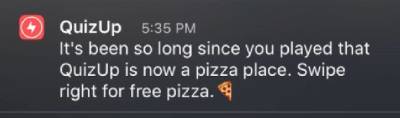
  • Guilt copy. “We miss you 😢” with no substance is the fastest route from dormant to uninstalled.
  • Discount-first sequences. If the first dormant touch is 20% off, you’ve set the price of returning — and trained users to wait for it.
  • No exit conditions. A user who opens the app exits every win-back tier immediately. Getting a “come back!” push the day after you came back reads as broken.
  • Ignoring quiet hours. Dormant users are the least forgiving audience for a badly timed send.

When app push can’t reach them anymore

Some dormant users are beyond app push: permission revoked, or the app is already gone. That’s a channel problem, not a lost customer. If you run web push on your site, the same person may still be reachable there; WhatsApp covers the highest-value cases. We covered the cross-channel handoff in depth in how to re-engage users when app push can’t reach them — the gaming framing generalizes to any vertical.

Measure resurrection, then LTV

The first metric is resurrection rate: what share of each tier opens the app within 7 days of its message. Healthy programs see meaningful recovery from the cooling tier, less from dormant, and honest single digits from the last call — which is the argument for catching users early. The metric that sells the program internally is recovered LTV: attach goal tracking so purchases from resurrected users are attributed to the tier that recovered them, and compare that revenue to what those cohorts would have generated dormant, which is approximately nothing.

Catch them while they’re still one tap away

Win-back is the cheapest acquisition you’ll ever run: the install, the permission, and the purchase history already exist. Build the three tiers as triggered campaigns, wire the exit conditions, and let it run. Pair it with the onboarding series on the front end and your lifecycle coverage is complete — and if you’re starting from zero on app push, the app push marketing guide and the iOS setup guide are the two tabs to open first.

添加评论

我们很高兴您选择留下评论。请记住,所有评论都将根据我们的隐私政策进行审核,并且所有链接都将是 nofollow。请勿在姓名字段中使用关键字。让我们进行一次个人化且有意义的对话。

在访客离开您的网站后与他们互动并挽留他们

通过难以忽略的推送通知,增加每次网站访问的价值。

  • 永久免费套餐
  • 轻松设置
  • 五星支持